

Finding the right ceramic bowl supplier in Vietnam is not just about getting the lowest price. Many importers realize too late that differences in glaze quality, firing methods, or production scale can directly affect their product consistency and brand reputation.
If you are planning to source ceramic bowls from Vietnam, this guide will help you understand what really matters from choosing the right production area to evaluating suppliers and placing orders with fewer risks.
1. Why Source Ceramic Bowls from Vietnam?
Vietnamese ceramic bowls stand out in the global market not simply because they are handmade, but because of how local clay composition, glazing techniques, and firing methods shape the final product. Unlike industrial ceramics, many Vietnamese workshops, especially in areas like Bat Trang, use clay that produces a slightly warm tone after firing.
Sourcing model:
Most international buyers sourcing ceramic bowls from Vietnam do not work directly with multiple small workshops. Instead, they rely on sourcing partners or consolidated suppliers who manage production, quality control, and logistics. This approach reduces communication gaps and ensures more consistent output, especially when dealing with handmade processes.
Trade agreements:
Vietnam participates in major trade agreements such as CPTPP, EVFTA, and RCEP, which can reduce or eliminate import duties in key markets like Canada, the EU, Japan, and Australia. For ceramic bowls, this directly impacts landed cost and pricing competitiveness. Over time, these advantages make it easier for importers to maintain margins while scaling volume in international markets.
Cost advantage:
Vietnamese ceramic bowls benefit from a cost structure that is still competitive compared to other major sourcing countries. Labor remains more affordable than in China, while local availability of clay helps keep raw material costs relatively stable. When comparing quotes for similar bowl designs (same glaze style, thickness, and firing level), Vietnamese suppliers often offer better pricing for mid-range handmade quality, not just low-end mass production.
Margin potential:
Vietnamese ceramic bowls are often positioned as “handcrafted” or “artisan-inspired” in Western markets. This creates a gap between production cost and perceived value. When combined with thoughtful design (matte glaze, neutral tones, modern shapes), these products can be sold at a significantly higher retail price. In many cases, the margin comes not from lowering cost, but from aligning product design with market expectations.
This is why many international buyers are actively looking for ceramic bowls wholesale Vietnam, especially when scaling product lines for retail or hospitality markets.
2. Types of Ceramic Bowls You Can Import in Vietnam
Vietnamese ceramic bowls are not a single product category. They vary significantly in shape, thickness, glaze, and firing technique, which directly affects how they are used and sold in international markets. For wholesale buyers, understanding each type helps you choose the right product for your target segment, rather than sourcing based on appearance alone.
2.1. Salad & Serving Bowls
Salad and serving bowls are typically larger, with a wider opening and balanced depth. Vietnamese versions often feature smooth hand-applied glaze and neutral tones, which work well for modern table settings.
Typical specifications (reference range):
- Diameter: 20 – 30 cm
- Height: 7 – 12 cm
- Capacity: ~1.5 – 4 liters
Common uses:
- Serving salad, pasta, fruit, or shared dishes
- Table centerpiece for dining settings
- Styling product in home décor or kitchen displays
Larger sizes increase perceived value and are suitable for bundle sets (2 – 3 pieces). However, they also increase shipping cost due to volume and weight.
2.2. Pasta Bowls
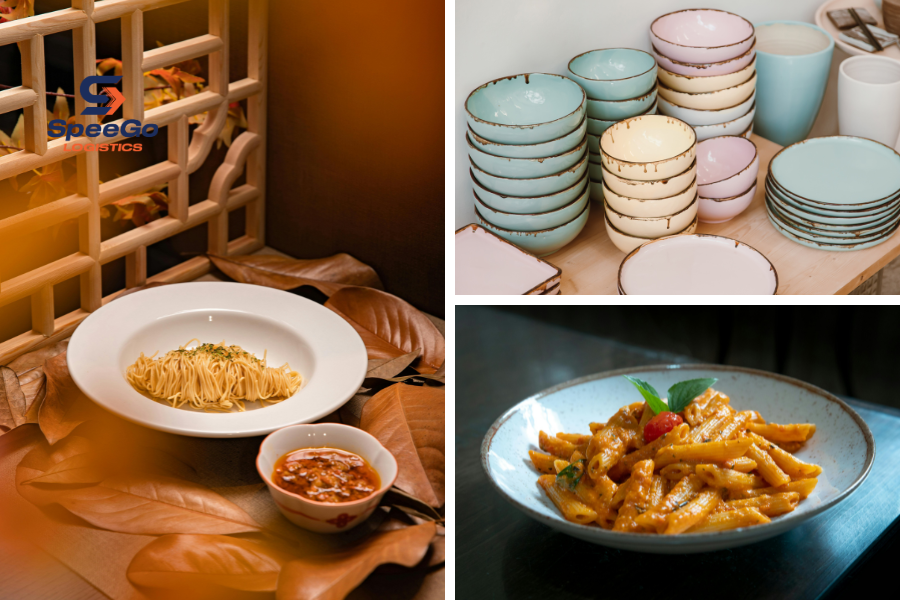
Pasta bowls sit between plates and deep bowls. They usually have a wide rim and shallow center, designed for dishes with sauce. This category aligns well with Western dining habits. It is suitable for both retail and restaurant use, especially in mid-range and premium segments.
Typical specifications:
- Diameter: 22 – 28 cm
- Height: 4 – 6 cm
- Capacity: ~700 – 1,200 ml
Common uses:
- Pasta, risotto, curry dishes
- Meals that require both solid and liquid components
- Restaurant plating (modern dining style)
2.3. Cereal Bowls
Cereal bowls are medium-sized and designed for daily use. Vietnamese suppliers often produce them with simple shapes, even glaze coverage, and stackable forms for bulk orders. This category is highly competitive, so buyers should focus on color sets or packaging differentiation.
Typical specifications:
- Diameter: 12 – 16 cm
- Height: 5 – 7 cm
- Capacity: ~400 – 700 ml
Common uses:
- Breakfast (cereal, milk, yogurt)
- Snacks or light meals
- Everyday household use
2.4. Soup Bowls
Soup bowls are specially designed dishes intended for serving soups and broths. They typically have a larger, deeper shape to hold enough liquid and ingredients comfortably. Some soup bowls come with handles, making it easier to hold hot contents, while others are handleless but may be broader around the rim.
Typical specifications:
- Diameter: 14 – 18 cm
- Height: 6 – 9 cm
- Capacity: ~500 – 900 ml
2.5. Dessert Bowls
Dessert Bowls are small, usually shallow dishes designed specifically for serving sweet treats. They are commonly used for presenting items like puddings, ice cream, fruit salads, or other delicate desserts.
Typical specifications:
- Diameter: 10 – 14 cm
- Height: 4 – 6 cm
- Capacity: ~200 – 400 ml
Common uses: Ice cream, fruit, small portions
2.6. Rice Bowls
Rice bowls are a traditional product in Vietnam and are widely produced. They are compact, easy to hold, and designed for individual portions.
Typical specifications:
- Diameter: 10 – 13 cm
- Height: 5 – 7 cm
- Capacity: ~250 – 400 ml
Common uses:
- Rice, side dishes
- Small meal portions
- Restaurant service (Asian cuisine)
2.7. Dip Bowls
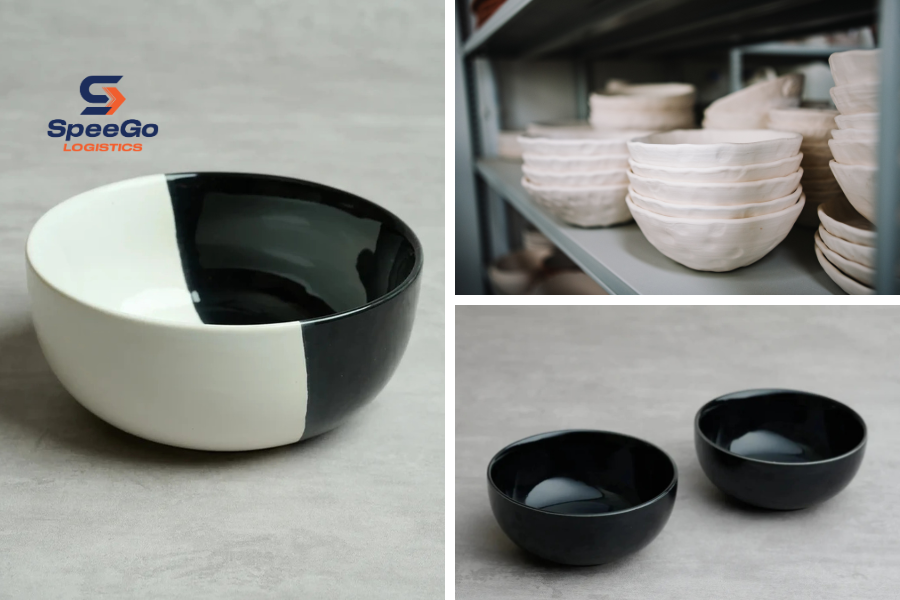
Dip bowls are small, shallow dishes designed specifically for serving various dips, sauces, or condiments. They are typically compact, making them ideal for holding items like salsa, hummus, guacamole, soy sauce, or salad dressings.
Typical specifications:
- Diameter: 6 – 10 cm
- Height: 2 – 4 cm
- Capacity: ~50 – 150 ml
Common uses: Sauces, spices, side servings
Beyond ceramic bowls, many buyers expand their product lines by exploring other items made in Vietnam, especially in home décor and kitchenware categories. This includes wooden tableware, bamboo products, and lacquerware, which can be sourced alongside ceramics to create a more complete product collection.
3. Key Ceramic Production Areas in Vietnam (Craft Villages & Factories)
Vietnamese ceramic bowls are not produced in a single type of facility. Instead, production is divided between traditional craft villages and export-oriented factories, each offering different advantages in terms of design, consistency, and scalability.
3.1. Traditional Ceramics Villages
Traditional ceramic villages in Vietnam are known for their handcrafted techniques and cultural heritage. These areas are suitable for buyers looking for unique designs rather than mass production.
- Bat Trang Village (Hanoi): One of the most established ceramic hubs in Vietnam, known for high-fired ceramics, stable glaze quality, and strong export experience. Many workshops here can handle both small-batch handmade orders and mid-scale production.
- Chu Dau (Hai Duong): Focuses more on artistic and heritage-inspired ceramics, often used for decorative products or premium collections rather than daily-use bowls
- Phu Lang (Bac Ninh): Known for rustic-style ceramics with thicker clay bodies and natural finishes, suitable for niche markets.
While these villages offer strong design identity, buyers should be aware of potential variations in size, glaze, and color between batches. Craft villages are the main source of handmade ceramic bowls Vietnam, offering unique designs that are difficult to replicate in mass production. For businesses planning to import from Vietnam through craft villages, it is important to understand that production timelines are less predictable compared to factory environments. Working with experienced local coordinators can help manage expectations and reduce delays.
3.2. Ceramics Factories
In addition to traditional villages, Vietnam also has export-oriented ceramic factories that focus on consistency, scalability, and international standards. Factories in Binh Duong and Dong Nai are typically equipped with modern kilns and standardized production processes. These suppliers are better suited for large-volume orders where uniformity and delivery timelines are critical.
Compared to small workshops, factories often provide:
- More consistent sizing and glaze finish
- Higher production capacity
- Better packaging and export documentation support
However, customization may be less flexible compared to traditional craft villages, especially for highly artistic designs. Factories are typically the preferred bulk ceramic bowls supplier for businesses that require large volumes and consistent quality. In many cases, international buyers collaborate with a Vietnam sourcing agent to bridge the gap between factories and overseas requirements. This helps ensure that production standards, packaging, and timelines are aligned before goods are shipped.
3.3. Which Production Area Fits Your Business?
Choosing between craft villages and ceramic factories depends on your sourcing goals, order volume, and target market. If your focus is on unique, handcrafted ceramic bowls with strong design identity, traditional villages like Bat Trang are more suitable. They offer flexibility in design and smaller batch production, which is ideal for boutique brands or premium positioning.
On the other hand, if you require consistent quality, larger volumes, and stable delivery timelines, export-oriented factories provide a more reliable solution. This is especially important for retailers, wholesalers, or businesses scaling their product lines.
For many importers, the most effective approach is combining both:
- Use craft villages for product development and differentiation
- Use factories for scaling proven designs
Understanding this distinction helps you choose the right ceramic bowl supplier in Vietnam based on your actual business needs, rather than sourcing blindly. Depending on your sourcing strategy, you may choose to work with a Vietnamese ceramic manufacturer, a bulk ceramic bowls supplier, or a sourcing partner. Each option offers different advantages depending on whether you prioritize handmade ceramic bowls Vietnam or scaling ceramic bowls wholesale Vietnam for larger markets.
4. How to Place Bowls from Vietnam?
If you are planning to import from Vietnam for the first time, understanding the ordering process is critical. Clear communication, proper documentation, and realistic production timelines all play a role in avoiding costly mistakes.
4.1. Define your bowl specifications clearly
Vietnamese suppliers rely heavily on visual references. A clear tech pack or even annotated images will help them match your expectations more accurately. The more detailed your input, the easier it is to avoid issues such as size mismatch or glaze variation.
- Bowl type (e.g., pasta bowl, rice bowl, serving bowl)
- Diameter, height, and capacity (ml or oz)
- Clay type or weight preference (lightweight vs thick-wall bowls)
- Glaze finish (matte, glossy, speckled, or solid color)
- Color consistency requirements across batches
- Logo placement or packaging if needed
4.2. Request physical samples (not just photos)
Because many bowls are partially handmade or kiln-fired in batches, small variations are normal. Reviewing physical samples allows you to define acceptable tolerance levels before placing bulk orders.
4.3. Pricing and MOQs
Pricing for Vietnamese ceramic bowls varies depending on how they are made like:
- Simple cereal bowls or rice bowls: lower cost, lower MOQ
- Larger serving bowls or pasta bowls: higher cost due to size and firing space
- Bowls with layered glaze or color variation: higher price due to additional processing
Typical MOQs:
- Standard designs: ~100 – 200 pieces per model
- Custom designs: ~300 – 500+ pieces depending on complexity
Pricing also depends on how suppliers position their products within the broader category of items made in Vietnam. Handmade ceramics often carry higher perceived value, especially when design and finish align with international trends.
5. How to Find a Reliable Ceramic Bowl Supplier in Vietnam?
Finding a reliable ceramic bowl supplier in Vietnam is not just about comparing prices. Buyers need to evaluate whether the supplier can deliver consistent quality, meet export standards, and scale production as demand grows.
5.1. Manufacturer vs Trading Company
Many suppliers online are trading companies rather than actual manufacturers. While trading companies can simplify sourcing, they often add cost and reduce control over production. If you are sourcing ceramic bowls wholesale Vietnam, working directly with a manufacturer helps improve pricing transparency and customization capability.
5.2. Experience with Export Markets
A reliable Vietnamese ceramic manufacturer should have experience exporting to markets such as the US, Canada, or EU.
This includes:
- Understanding packaging standards
- Handling export documentation
- Meeting product safety requirements
5.3. Quality Control System
Consistency is one of the biggest challenges when sourcing handmade ceramic bowls Vietnam.
Ask suppliers:
- Do they have batch inspection?
- How do they control glaze variation?
- Can they provide QC reports?
5.4. MOQ and Production Flexibility
Different suppliers offer different MOQs depending on production setup. Choosing the right supplier depends on whether you prioritize flexibility or scalability.
As global demand for items made in Vietnam continues to grow, businesses that approach sourcing strategically will gain a clear advantage. Whether you plan to import from Vietnam at a small scale or build a long-term supply chain, having the right sourcing agent in Vietnam is essential for sustainable growth.
Finding Ceramic Bowl Supplier in Vietnam With SpeeGo Logistics
If you are planning to source ceramic bowls from Vietnam but want to avoid dealing with multiple suppliers, quality issues, and shipping coordination, working with an integrated partner can make the process much smoother.
SpeeGo Logistics supports businesses from supplier sourcing to final delivery, helping you reduce risks and manage everything within one streamlined workflow.
Contact SpeeGo today to simplify your sourcing process.
Frequently Asked Questions (FAQs)
- How do I know if a ceramic bowl supplier in Vietnam is a real manufacturer or just a trading company?
Many suppliers online present themselves as factories, but are actually intermediaries. A reliable way to verify is by asking for production videos, kiln images, and factory audits. Manufacturers can usually provide more detailed technical answers about clay composition, firing temperature, and glaze control.
- What level of variation is acceptable when sourcing handmade ceramic bowls from Vietnam?
Because many Vietnamese ceramic bowls are partially handmade and kiln-fired in batches, slight differences in color tone, glaze texture, or size are normal. Buyers should define acceptable tolerance levels during the sampling stage to avoid disputes in bulk orders.
- What factors affect the price of ceramic bowls in Vietnam?
Pricing is influenced by several key factors:
- Clay type and thickness
- Glaze technique (matte, reactive glaze, hand-painted)
- Firing temperature and kiln type
- Order quantity (economies of scale)
- Small design changes can significantly impact cost.
- Should I work directly with suppliers or use a sourcing agent in Vietnam?
If you have experience and local presence, direct sourcing may reduce costs. However, many businesses choose sourcing agents to manage supplier verification, quality control, and logistics, especially when scaling or dealing with multiple suppliers.