

Instead of treating artificial intelligence as a future trend, many businesses are now focusing on how to use AI in logistics to solve real operational challenges. From optimizing delivery routes to improving demand forecasting and inventory control, AI is already being applied across multiple stages of the supply chain. However, knowing where to start and how to apply AI effectively remains a key concern for many companies.
1. What Does It Mean to Use AI in Logistics?
Understanding how to use AI in logistics means applying data-driven systems to improve daily operations such as transportation, warehousing, and inventory management. Instead of relying on manual processes, businesses can use AI to analyze real-time and historical data, optimize routes, forecast demand, and respond faster to disruptions. In practice, AI works as an added intelligence layer that enhances existing workflows rather than replacing them entirely.
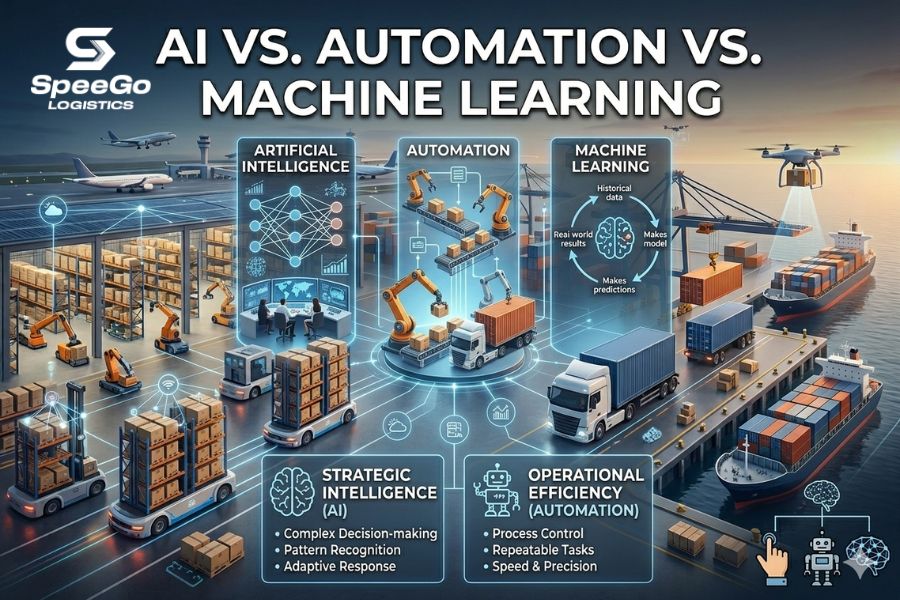
Artificial Intelligence, Automation, and Machine Learning
Before exploring how to use AI in logistics, it is important to distinguish between three commonly confused concepts:
- Automation refers to handling repetitive, rule-based tasks without human input. In logistics, this could include automatically sending shipment updates or generating invoices based on predefined rules.
- Machine Learning (ML) is a subset of AI that enables systems to learn from past data and improve over time. For example, ML models can analyze historical sales patterns to forecast demand more accurately.
- Artificial Intelligence (AI) is the broader concept that combines automation, machine learning, and advanced algorithms to simulate decision-making. In logistics, AI can dynamically adjust delivery routes based on traffic, weather conditions, or unexpected supply chain disruptions.
In short, automation executes tasks, machine learning improves predictions, and AI connects both to support smarter, real-time decisions across logistics operations.
2. Key Areas Where AI Can Be Applied in Logistics
To understand how to use AI in logistics effectively, businesses need to focus on specific operational areas where AI can deliver measurable impact. Rather than applying AI broadly, most companies begin with targeted use cases that solve clear problems in transportation, warehousing, and supply chain planning.
2.1. Route Optimization and Transportation Planning
One of the most practical applications of using AI in logistics is route optimization. AI systems can analyze real-time traffic data, weather conditions, and historical delivery patterns to recommend the most efficient routes. This helps reduce fuel consumption, shorten delivery times, and improve overall fleet utilization.
2.2. Demand Forecasting
AI plays a critical role in predicting customer demand more accurately. By analyzing historical sales data, seasonal trends, and external factors, AI models can generate more reliable forecasts. This allows businesses to plan inventory and production more effectively.
2.3. Inventory Management and Optimization
Managing inventory efficiently is a key challenge in supply chains. AI systems help track stock levels in real time, predict replenishment needs, and optimize inventory distribution across different locations. Instead of relying on static rules, ai in supply chain management enables dynamic adjustments based on actual demand patterns.
2.4. Warehouse Automation and Smart Operations
Warehouses are increasingly adopting AI-driven automation to improve speed and accuracy. AI can optimize picking routes, manage storage layouts, and coordinate automated equipment such as robots or conveyor systems.
2.5. Supply Chain Visibility and Risk Management
Another important area is improving visibility across the supply chain. AI systems can track shipments in real time, identify potential delays, and suggest alternative solutions when disruptions occur. This level of transparency allows businesses to respond more quickly to issues and maintain better control over operations, especially in complex global supply chains.
The most effective way to approach how to use AI in logistics is to focus on high-impact areas such as transportation, forecasting, inventory, and warehouse operations. To truly optimize sourcing and logistics, businesses also need the right partners on the ground.
SpeeGo Logistics provides end-to-end sourcing services from A to Z, helping you identify reliable suppliers, verify product quality, negotiate pricing, and manage the entire procurement process in China.
Work with SpeeGo Logistics to turn your sourcing strategy into a structured, scalable system, from supplier selection to final delivery.
3. Benefits of AI in Logistics for Businesses
Adopting AI in logistics is no longer just a trend but it has become a practical solution for companies aiming to improve operational efficiency and remain competitive. Across the ecosystem of DHL and McKinsey & Company, research consistently highlights how AI technologies can enhance decision-making, streamline workflows, and reduce inefficiencies in logistics operations.
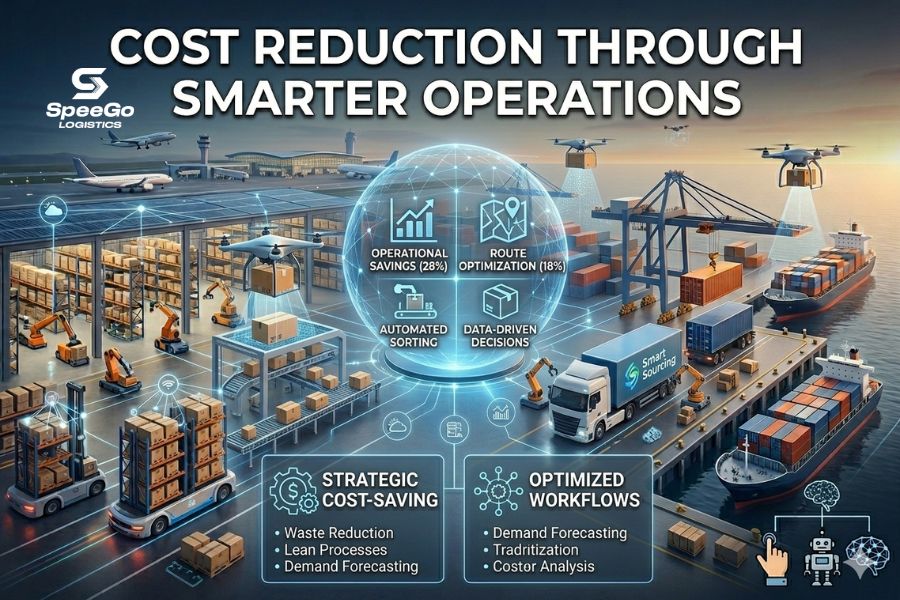
3.1. Cost Reduction Through Smarter Operations
One of the most immediate benefits of AI in logistics and supply chain is cost optimization. AI systems can analyze large volumes of operational data to identify inefficiencies in transportation, warehousing, and inventory management.
- Route optimization reduces fuel consumption and delivery time
- Demand forecasting minimizes overstocking and stockouts
- Automation lowers labor-intensive processes
3.2. Improved Operational Efficiency
AI enhances logistics efficiency by automating repetitive tasks and improving coordination across the supply chain.
- Warehouse automation speeds up picking and packing
- Real-time tracking improves shipment visibility
- AI-powered systems reduce manual errors
DHL has highlighted in its logistics trend reports that AI-driven automation helps companies handle higher order volumes with the same or fewer resources.
3.3. Higher Accuracy in Forecasting and Planning
Accurate forecasting is critical in logistics. AI models can process historical data, seasonal patterns, and market signals to generate more precise demand predictions.
- Better inventory planning reduces excess stock
- Improved demand forecasting supports production scheduling
- Data-driven insights enable proactive decision-making
Compared to traditional methods, ai in logistics industry provides a more dynamic and responsive approach to planning
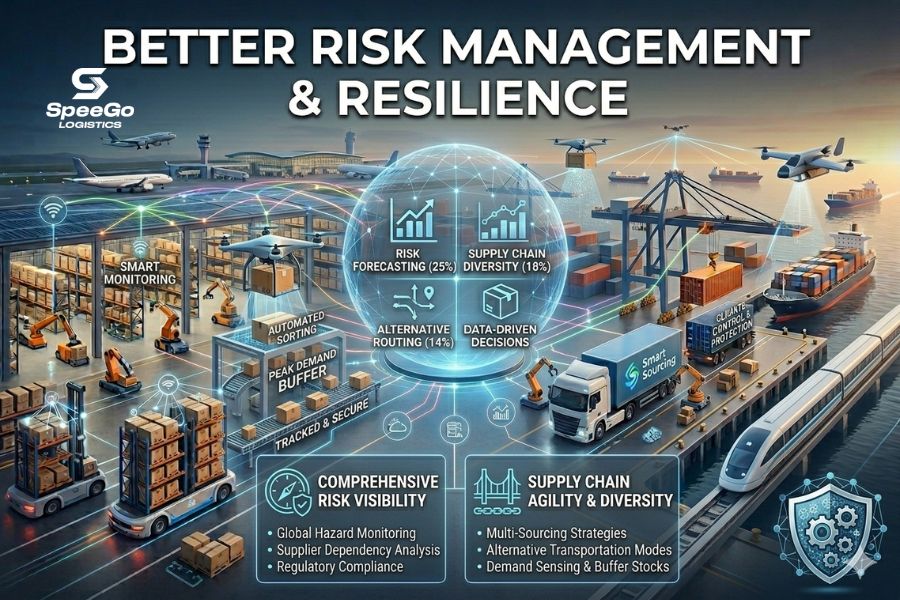
3.4. Better Risk Management and Resilience
Supply chains are increasingly exposed to disruptions, from demand fluctuations to global events. AI helps businesses anticipate and respond more effectively.
- Early detection of supply chain risks
- Alternative route suggestions during disruptions
- Data-backed contingency planning
This improves overall resilience and reduces the impact of unexpected events.
The benefits of AI in logistics extend far beyond automation. From cost reduction and efficiency gains to better forecasting and customer experience, AI enables businesses to build smarter and more resilient supply chains.
4. How to Use AI in Logistics?
Getting started with AI in logistics needs a strategic approach that extends beyond simply purchasing or developing software. It is a phased process that involves understanding business requirements, establishing a solid data foundation, and preparing the workforce.
4.1. Identifying a Clear Business Problem
The first step is defining a practical use case rather than adopting AI for its own sake. Many companies begin with issues such as delayed deliveries, inaccurate demand forecasts, or inefficient warehouse operations. By narrowing the scope, businesses can apply AI where it delivers immediate value.
Consider some questions such as:
- What are the primary causes of customer dissatisfaction? (For instance, delayed deliveries or insufficient tracking information)
- What tasks consume the most time for our staff? (Such as manual route scheduling, handling customer inquiries, or processing paperwork)
- Which areas are we experiencing the greatest financial losses? (For example, fuel expenses, excessive return rates, or warehouse errors)
4.2. Starting with Available Data
Once the problem is defined, companies typically assess the data they already have. Logistics operations generate large amounts of information, including shipment history, inventory levels, and delivery performance.
Rather than building complex systems from the start, businesses often begin by organizing and analyzing existing data. This step is critical because AI models rely on data quality to produce reliable insights.
4.3. Running Small-Scale Pilot Projects
Instead of deploying AI across the entire supply chain, companies usually test it in a controlled environment. This could involve optimizing routes for a single region or applying demand forecasting to a specific product category.
4.4. Measuring Results and Adjusting the Strategy
After implementation, companies track key performance indicators such as delivery time, cost savings, or inventory turnover. These metrics provide a clear view of whether the AI solution is delivering value. If the results are positive, the business can expand the application to other areas. If not, adjustments can be made without affecting the entire operation. This iterative process is a key part of using AI in logistics effectively.
The process of adopting how to use AI in logistics is not about immediate transformation, but about starting small and scaling intelligently. Businesses that focus on clear use cases, reliable data, and measurable outcomes can turn AI into a practical tool for improving logistics performance.
5. Build vs. Buy AI in Logistics Solutions
When exploring how to use AI in logistics, one of the most important decisions businesses face is whether to build AI solutions internally or purchase ready-made platforms. This choice affects cost, scalability, implementation speed, and long-term flexibility.
5.1. Building AI Solutions In-House
Developing AI systems internally gives businesses full control over how technology is designed and applied. This approach is often chosen by companies with strong technical teams and highly specific logistics requirements.
Key advantages of building AI:
- Full customization based on internal workflows
- Deep integration with existing systems
- Greater control over data and algorithms
- Potential long-term competitive advantage
Main challenges:
- High upfront and ongoing costs
- Longer development and deployment timelines
- Need for specialized AI and data expertise
- Continuous maintenance and optimization

5.2. Buying AI Solutions from Vendors
Purchasing AI tools from external providers allows businesses to implement using AI in logistics more quickly without building systems from scratch. Many logistics platforms already include AI-powered features such as route optimization and demand forecasting.
Key advantages of buying AI:
- Faster implementation and time-to-value
- Lower initial investment compared to in-house development
- Access to proven, ready-made solutions
- Reduced technical complexity
Limitations to consider:
- Limited customization options
- Dependence on vendors for updates and support
- Potential integration challenges with existing systems
Many companies adopt a hybrid strategy to balance flexibility and efficiency. Instead of choosing one approach, they combine external tools with internally developed solutions.
In conclusion, understanding how to use AI in logistics is no longer optional for businesses aiming to stay competitive in a fast-evolving market. The key is to start with clear goals, reliable data, and the right implementation strategy so that AI becomes a tool for real business impact rather than just a technological trend.