

Sourcing Vietnamese lacquerware can be highly profitable, but finding reliable wholesale suppliers is often challenging without local knowledge. From quality inconsistencies to communication barriers, many importers face hidden risks.
This guide is based on real sourcing practices in Vietnam, helping businesses reduce risks and make better supplier decisions..
1. What is Vietnamese Lacquerware?
Vietnamese lacquerware refers to a traditional craft that uses natural resin, known as “lacquer”, extracted from the Rhus succedanea tree. This material is applied in multiple layers onto a base such as wood, bamboo, or composite, then polished to create a smooth, durable, and often glossy surface. Unlike factory-made coatings, lacquer requires time, precision, and skilled hands. Each product goes through a detailed process that includes layering, drying in controlled conditions, sanding, and hand-finishing.
The origins of lacquerware in Vietnam date back hundreds of years, evolving from functional household items into decorative and artistic products. Today, it is widely recognized as both a cultural symbol and a commercial export category. As a result, Vietnamese lacquerware is not only a traditional craft but also a growing export category supported by a wide network of lacquerware manufacturers in Vietnam.
2. Why Choose Lacquerware in Vietnam?
Vietnamese lacquerware has moved beyond being a traditional craft. Today, it is a strong export category that attracts buyers in the US, Canada, and Europe. For businesses looking to source unique, high-margin products, this segment offers clear commercial potential. According to the Vietnam Trade Promotion Agency, handicrafts including lacquerware are among the key export categories with growing demand in international markets.
- Strong Cultural Identity and Craftsmanship: Vietnamese lacquerware reflects centuries of craftsmanship, making each product more than just a decorative item. This gives brands a unique advantage in storytelling and positioning.
- Rising Demand for Sustainable Home Decor: Consumer behavior is shifting toward eco-conscious purchasing. Many items made in Vietnam now adapt their materials and processes to align with international expectations.
- Flexible Customization for Private Labels: Vietnamese suppliers often support OEM and ODM production. This allows businesses to customize designs based on target markets.
- Competitive Sourcing with Skilled Labor: Vietnam offers a balance between cost efficiency and craftsmanship quality. While production is manual, labor remains competitive compared to many other countries.
- Easier Access Through Trade and Logistics Networks: With multiple free trade agreements and a growing export ecosystem, import from Vietnam is becoming more accessible.
As a result, Vietnamese lacquerware has become a key category within Vietnam home decor suppliers, especially for brands targeting premium and handmade product segments.
3. Where are The Best Vietnamese Lacquerware Suppliers?
Finding the right supplier is one of the most critical steps when sourcing Vietnamese lacquerware. The challenge is not a lack of suppliers, but knowing which channel fits your business model, budget, and risk tolerance.
Below are the most reliable sourcing options, including traditional craft villages, modern platforms, and on-the-ground support.
3.1. Traditional Craft Villages (Authentic but Require Experience)
Vietnamese lacquerware is closely tied to specific craft villages, where production skills have been preserved for generations.
Some of the most well-known lacquerware villages include:
- Ha Thai Village (Hanoi): one of the largest lacquerware production hubs
- Cat Dang Village (Nam Dinh): known for fine art lacquer pieces
- Binh Duong Province: a major center for export-oriented lacquerware manufacturing
Craft villages are ideal if you want authentic products and differentiation, but they require local knowledge or a trusted intermediary.
Advantages:
- Direct access to skilled artisans
- Unique, handcrafted designs
- Flexible customization for small batches
Challenges:
- Limited English communication
- Lack of standardized export processes
- Quality consistency may vary between workshops
3.2. B2B Platforms (Fast Access, Higher Screening Needed)
Online platforms such as Alibaba or Global Sources allow buyers to quickly connect with multiple suppliers.
Advantages:
- Easy supplier comparison
- Access to verified exporters
- Suitable for initial research and price benchmarking
Challenges:
- Risk of trading companies posing as manufacturers
- Product images may not reflect actual quality
- Limited transparency in production capabilities
3.3. Trade Fairs and Exhibitions (Best for Direct Evaluation)
Trade fairs offer a valuable opportunity for buyers to meet suppliers in person and assess product quality firsthand, especially when sourcing handicraft from Vietnam such as lacquerware, where craftsmanship and finishing quality are critical.
Advantages:
- Physical product inspection
- Direct negotiation with suppliers
- Better understanding of design capabilities
Challenges:
- Travel cost and time investment
- Limited to specific event schedules
3.4. Local Sourcing Agents (Lower Risk, Higher Efficiency)
Working with a sourcing agent in Vietnam is often the most practical option for international buyers, especially those new to the market.
What they typically offer:
- Supplier identification and verification
- Price negotiation
- Quality control and production follow-up
- Logistics coordination
Advantages:
- Reduced communication barriers
- Faster problem-solving on the ground
- Lower risk of scams or misunderstandings
Challenges:
- Service fees (usually a percentage of order value)
- Quality depends on the agent’s experience
Each sourcing channel plays a different role depending on whether you are looking for small-batch handmade lacquerware in Vietnam or large-scale production. If you lack local presence, a Vietnam sourcing agent can help you avoid costly mistakes and save time, particularly when dealing with craft villages.
3.5. Direct Factory Sourcing (Best for Scaling)
Some lacquerware suppliers operate as export-ready factories. These manufacturers often combine traditional techniques with modern production systems. Factory sourcing is suitable for businesses that want to scale volume and maintain stable quality over time.
Advantages:
- Better consistency and quality control
- Clear production timelines
- Experience with international standards
Challenges:
- Higher MOQ compared to small workshops
- Less flexibility for highly customized designs
These sourcing options are commonly used by buyers looking for Vietnamese lacquerware manufacturers or wholesale suppliers depending on their business scale.
4. Best-Selling Vietnamese Lacquerware Products for Wholesale Buyers
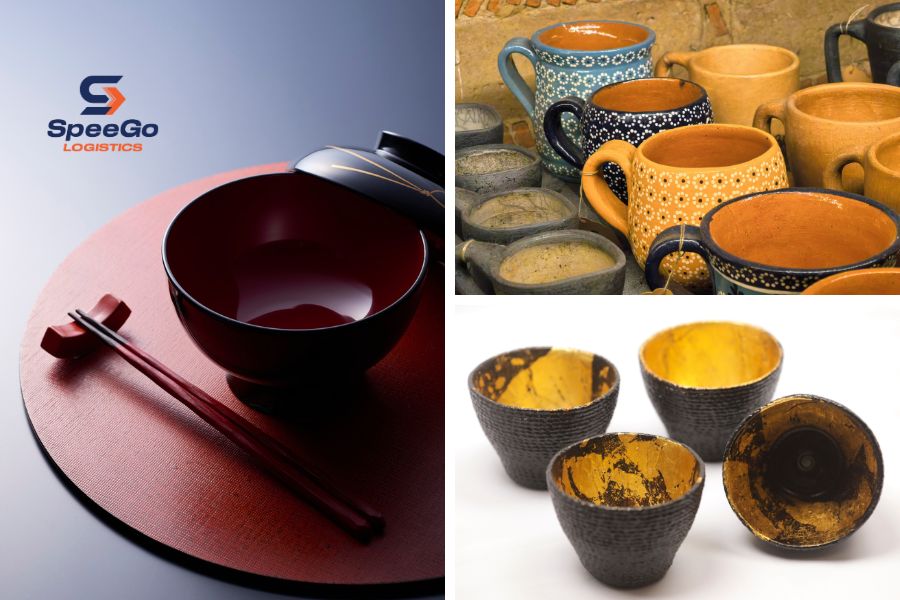
Vietnamese lacquerware has a distinct advantage in the global home décor market because of its layered coating technique, hand-polished finish, and depth of color that cannot be replicated by industrial materials. These characteristics make the products highly suitable for buyers targeting mid-to-premium segments, where visual identity and craftsmanship matter as much as functionality.
For wholesale buyers in the US and Canada, lacquerware is often positioned as “functional decor” or “artisan home accents” rather than purely utilitarian goods. This positioning allows higher margins and stronger brand storytelling, especially when combined with consistent design collections.
4.1. Lacquerware Bowls and Plates
Lacquerware bowls and plates are increasingly popular in Western markets, particularly in segments where customers value products that serve both decorative and practical purposes. Unlike ceramic or glass, Vietnamese lacquerware offers a lighter structure, smooth hand-polished surface, and deep, layered color tones such as matte black, charcoal, or earthy reds. These features make them suitable for display, serving dry food, or styling interior spaces.
From a buyer’s perspective, these items are easier to integrate into modern retail collections. They work well in kitchen decor, gift sets, and lifestyle branding, especially when designed in coordinated color palettes. However, importers should clearly position them as decorative or dry-use items unless coating compliance is verified with standards from the U.S. Food and Drug Administration. This transparency helps avoid customer confusion and builds long-term trust.
4.2. Lacquerware Vases and Boxes
Lacquerware vases and boxes are strong candidates for brands that want to stand out through design rather than compete on price. What makes Vietnamese lacquerware unique in this category is the ability to create multi-layered finishes, hand-applied textures, and decorative techniques such as eggshell inlay or metallic leaf accents. These details add depth and visual contrast, making each piece feel more curated than mass-produced alternatives.
These products offer clear advantages in branding. Vases can be positioned as statement décor pieces, while boxes are ideal for gift packaging, jewelry storage, or premium home accessories. They also support storytelling around craftsmanship and origin, which is increasingly important in North American markets.
4.3. Lacquerware Trays
Lacquer trays are one of the most stable and scalable product categories in Vietnamese lacquerware. Their flat surface makes them ideal for showcasing the signature lacquer finish smooth, reflective, and evenly layered, which is a key selling point for this material. They are also structurally simple, reducing production risks compared to more complex items.
If you are new importers from Vietnam, trays are often the best entry product because they balance reasonable MOQ, consistent quality, and broad market demand. They can be used for serving, decorative styling, or organizing spaces, making them suitable for a wide range of retail channels from home decor stores to online marketplaces
4.4. Lacquerware Statues
Lacquerware statues represent the more artistic side of Vietnamese craftsmanship, where the focus is on form, symbolism, and surface detailing. These products often involve more handwork, multiple lacquer layers, and careful polishing to achieve a refined finish, especially on curved or intricate shapes. As a result, each piece tends to have slight variations, which adds to its handcrafted appeal.
These categories are commonly offered by lacquerware wholesale Vietnam suppliers and can be adapted for different retail markets.
5. How to Evaluate a Reliable Vietnamese Lacquerware Supplier?
Choosing the right supplier is not just about price. In the lacquerware industry, where production is partly handmade, supplier capability directly affects product quality, delivery time, and your brand reputation.
This section provides a practical, experience-based checklist to help importers reduce risks and make informed decisions.
5.1. Verify Production Capability (Not Just Trading Activity)
One of the most common issues in Vietnam sourcing is confusing trading companies with actual manufacturers. Manufacturers usually offer better control over customization, pricing, and timelines. Trading companies may add cost without improving quality.
So you should ask for a video of the production process, including lacquer layering and polishing stages. This is difficult to fake and gives insight into real capabilities.
5.2. Materials and Lacquer Type
Understanding materials is essential when sourcing Vietnamese lacquerware. The type of lacquer and base material directly affects durability, appearance, compliance, and cost. For premium markets (US, Canada), natural or high-quality semi-natural lacquer is often preferred due to its authenticity and perceived value.
5.3. Base Materials
The base material forms the core structure of lacquerware. It influences not only durability but also shipping cost and target market positioning. There are some popular base materials in Vietnam.
- Wood (MDF or natural wood): Most common for trays, boxes, and furniture decor.
- Bamboo: Suitable for sustainable product lines.
- Composite materials: Used for complex shapes.
5.4. OEM/ODM Capability (Customization Matters)
Skilled workshops in Vietnam are also able to combine traditional techniques with contemporary forms, which is especially valuable for brands targeting premium or design-focused segments. Buyers can request specific color tones (matte black, deep red, eggshell inlay), surface effects (glossy, satin, distressed), or even handcrafted patterns that reflect cultural or modern design trends.
However, this level of customization requires close collaboration with suppliers who understand layering techniques and finishing standards. Workshops that cannot control color consistency or surface quality across batches will struggle to meet market expectations.
5.5. MOQ, Pricing Structure, and Lead Time
In Vietnamese lacquerware, MOQ and pricing are closely tied to the number of lacquer layers and the complexity of hand-finishing. Products with smooth, high-gloss surfaces or detailed decorative work require more coating cycles and polishing time, which increases both cost and minimum order requirements. As a result, realistic timelines for bulk orders usually range from 30 to 60 days with around 200 – 1000 units per product.
6. Shipping and Export Considerations for Vietnamese Lacquerware
Shipping Vietnamese lacquerware is not the same as handling standard consumer goods. Due to its handcrafted nature and layered surface treatment, lacquerware requires careful planning throughout packaging, transportation, and documentation.
This section outlines the key considerations to help you manage shipping more efficiently when importing from Vietnam.
6.1. Fragile Packaging and Surface Protection
Although lacquerware is known for its durability, the surface can still be vulnerable to scratches, cracks, or dents during transit. This is especially true for high-gloss or multi-layered finishes, which require extensive polishing.
6.2. Moisture Control and Climate Sensitivity
Lacquerware products are sensitive to humidity and temperature changes, particularly during long transit times. For shipments to markets with extreme weather conditions, such as Canada or parts of the United States, climate variation during transit can be significant. This makes moisture control a critical part of quality assurance.
6.3. Export documents
Common export documents include Commercial Invoice, Packing List, and Bill of Lading. For certain markets, additional labeling or compliance documentation may be required.
6.4. Shipping to Key Markets (USA, Canada, Australia)
Each destination market has its own logistics considerations. Businesses should prepare accordingly:
- Shipping from Vietnam to USA: Longer transit routes and stricter customs inspections require accurate documentation and strong packaging standards
- Shipping from Vietnam to Canada: Climate variation makes moisture protection more important
- Shipping from Vietnam to Australia: Biosecurity regulations may apply, especially for products using natural materials like wood or bamboo
Understanding these differences helps reduce clearance risks and ensures smoother delivery timelines.
Looking for a reliable Vietnamese lacquerware wholesale supplier?
Working with an experienced sourcing partner can help you verify suppliers, control quality, and manage shipping more efficiently.
Contact SpeeGo Logistics to simplify your sourcing process from Vietnam.