
Vietnamese ceramics are not only traditional handicraft products rich in cultural heritage but are also increasingly valuable export items in major markets such as the U.S., EU, Japan, and Australia. This article aims to provide businesses with a comprehensive overview of the Vietnamese ceramics industry and highlight key factors to prepare when exporting, especially in the context of increasingly stringent and competitive markets.
1. Overview of the Vietnamese Ceramics Industry
Vietnam’s ceramics industry is one of the oldest artisan sectors, with a growing scale of production and exports. According to the Ministry of Industry and Trade, from 2019 to 2023, the export value of Vietnamese ceramics grew at an average rate of about 3.5% annually. The highest export turnover was recorded in 2022, reaching USD 711 million, before experiencing a slight decline in 2023 and then recovering in early 2024.
The General Department of Customs reports that in the first half of 2024, the U.S. remained Vietnam’s largest ceramics export market. Total ceramic exports during this period reached USD 317 million, with the U.S. accounting for nearly USD 81 million, representing about 25.5% of the market share, up nearly 56% compared to the same period last year. This reflects the strong demand from the U.S. market for Vietnamese ceramics, especially decorative items, kitchenware, and household utensils.
Besides the U.S., Vietnamese ceramics are also exported to Japan, the EU, South Korea, and Australia, demonstrating widespread acceptance across developed regions. Trade data for 2023 shows that the HS code 691200 (dinnerware, kitchenware, and other ceramic products) generated approximately USD 3.3 million in exports from Vietnam, with the U.S. being one of the leading markets, valued at about USD 650,500, followed by South Korea, Japan, and Italy.
2. History of Vietnamese Ceramics
Vietnamese ceramics have a history closely linked to the nation’s development. Archaeological findings reveal ceramic artifacts dating back to the Phung Nguyen Culture (around 2000 – 1500 BC) and the Dong Son Culture (7th century BC – 1st century AD). During these periods, ceramics primarily served daily life and ceremonial purposes, decorated with incised patterns, rope impressions, or geometric motifs.
Research indicates that during the Ly and Tran Dynasties (11th – 14th centuries), Vietnamese ceramics achieved high levels of technical and aesthetic refinement, characterized by celadon glazes, white porcelain, and intricate carved motifs. In the Early Le and Mac Period (15th – 16th centuries), Chu Dau ceramics from Hai Duong flourished, with findings on shipwrecks in the South China Sea attesting to Vietnam’s role in international trade.
Despite numerous historical upheavals, traditional craft villages such as Bat Trang (Ha Noi), Phu Lang (Bac Ninh) and Chu Dau (Hai Duong) have persisted and developed. Today, Vietnamese ceramics are valued not only for their utility but also as cultural and artistic products, combining traditional techniques with modern design to create a distinctive identity on the global market.
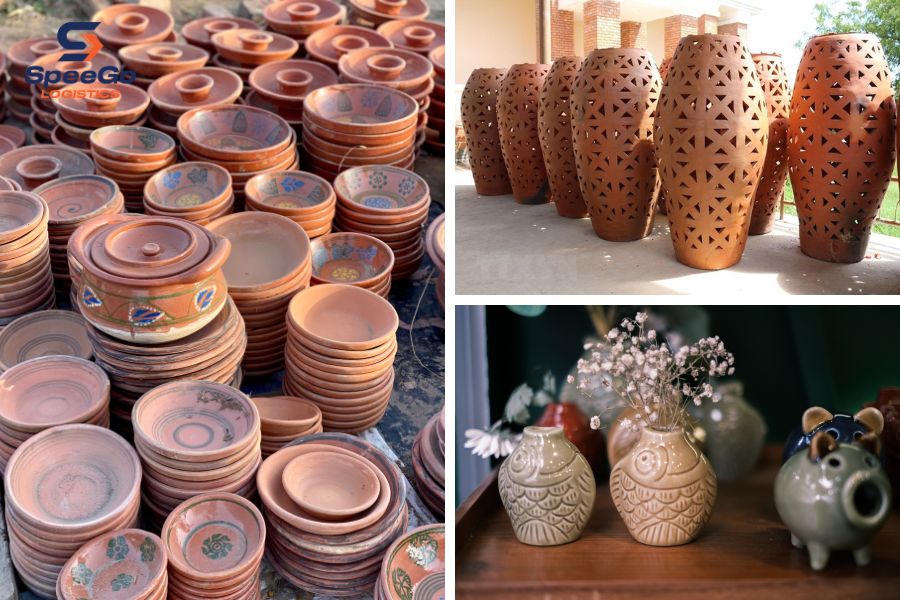
3. Traditional Ceramics Villages in Vietnam
3.1. Bat Trang Village – Ha Noi
Bat Trang is one of Vietnam’s most renowned ceramic centers. Currently, it produces dinnerware, decorative figurines, and has expanded into gift ceramics, feng shui items, and export ceramics to the U.S., Japan, and the EU. The village leads in integrating traditional techniques with modern firing methods such as gas and electric kilns, ensuring consistent quality for exports.
3.2. Chu Dau Village – Hai Duong
Chu Đậu ceramics are famous for their white-glazed products decorated with floral, landscape, and geometric motifs. The hallmark of Chu Dau ware is the translucent white glaze with a slightly ivory hue, creating a soft and pure appearance. Hand-painted with traditional brushwork, the motifs are fluid, with an emphasis on balance and open space, resulting in elegant compositions.
3.3. Phu Lang Village – Bac Ninh
Phu Lang is an ancient village known for its rustic brown ceramics, which exude simplicity and craftsmanship. Unlike the more elaborate white or celadon glazes, Phù Lãng ceramics feature a dark brown, almost black glaze with a slightly rough surface and natural color effects after high-temperature firing. Typical products include large jars, vases, and decorative items.
4. Why are Many Companies Choosing Vietnamese Ceramics for Export?
Amidst the ongoing volatility of the global supply chain, many international businesses are seeking alternative sources beyond China. Vietnam has emerged as a notable choice for ceramic exports, thanks to its combination of production capacity, skilled craftsmanship, and favorable trade policies.
4.1. Cost and Skilled Artisans
Vietnam boasts hundreds of traditional ceramic villages, such as Bát Tràng, Chu Đậu, and Phù Lãng, with centuries of expertise. Skilled artisans produce high-quality products, particularly decorative and artistic ceramics favored in the U.S. and Europe.
Moreover, many companies in the U.S., Australia, and Canada choose Vietnam for manufacturing due to lower labor costs. According to VinaSource, wages for ceramic artisans in Vietnam range from approximately VND 10 – 15 million per month (USD 430 – 650), whereas in China, wages can be between CNY 13,400 – 23,400 (USD 1,870 – 3,270). This wage difference provides a cost advantage, allowing Vietnamese exporters to offer competitive prices, especially for bulk orders, thus maximizing profit margins.
4.2. Government Support Policies
Vietnam’s government actively promotes the ceramic industry through various incentive programs. A notable initiative is Decision 801/QĐ-TTg, which aims to boost exports of handicrafts, including ceramics. This program supports key craft villages in expanding product designs, promoting trade activities, and connecting with international markets.
Vietnam is also a participant in major Free Trade Agreements (FTAs) such as EVFTA (with the EU), CPTPP, and RCEP. These agreements provide preferential tariffs for ceramics that meet origin criteria, facilitating exports to Europe, Canada, Australia, and other member countries.
4.3. Alignment with Sustainable Consumption Trends
The “handmade,” “artisanal,” and “sustainable” trends are increasingly influential in markets like the U.S., Canada, and Australia. Retailers value the storytelling aspect of products, each piece of pottery or tableware carries a story about its village, traditional techniques, and local culture. This differentiation is challenging for mass-produced industrial goods to replicate.
4.4. Flexible OEM/ODM Capabilities for International Brands
Many Vietnamese craft factories have invested in modern kiln technology and quality control systems that meet export standards. This enables them to undertake OEM/ODM orders for international brands, from restaurant and hotel dinnerware to products sold on Amazon, Etsy, or large retail chains.
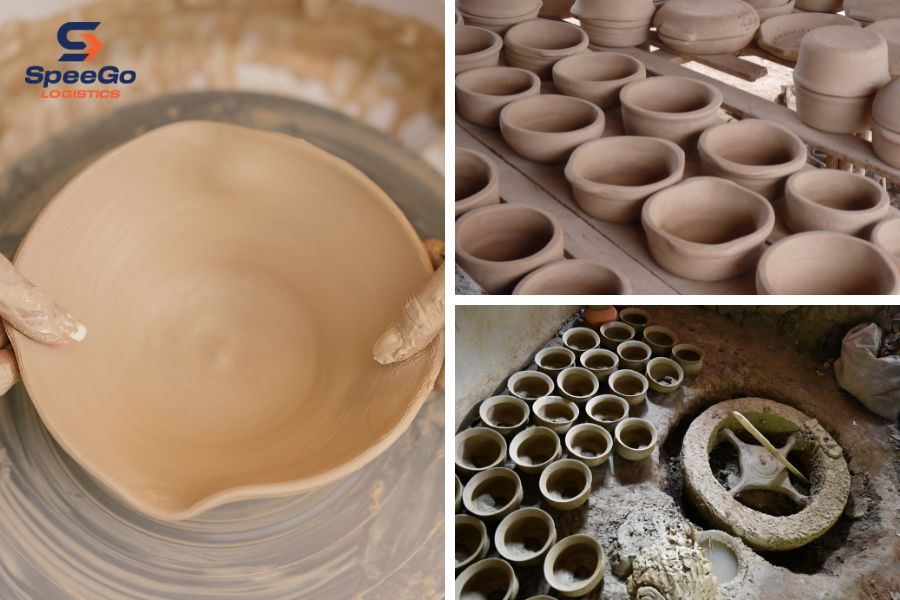
5. Standards for Exporting Vietnamese Ceramics
For products that come into direct contact with food, such as bowls, plates, cups, teapots, safety standards are non-negotiable. During manufacturing, lead (Pb) and cadmium (Cd) can be present in glazes, especially in colored glazes or low-temperature firing. These heavy metals pose health risks if they leach into food beyond permissible limits. Developed markets enforce strict controls on these substances.
5.1. Food Safety Regulations (for food-contact ceramics)
Lead and cadmium may be present in ceramic glazes, particularly in products fired at lower temperatures or those finished with coloured glazes. These two heavy metals are subject to strict regulation due to their potential health risks to consumers.
- America: FDA sets specific limits depending on product type (flatware, small containers, large containers). While pre-market approval isn’t required, shipments are subject to inspection and sampling at ports. Exceeding limits can lead to import refusals under “Import Alert.”
- Australia: Testing often follows international standards like ISO 6486, which measures lead and cadmium leaching. Non-compliance may result in product recalls.
- Canada: The Canadian Food Inspection Agency (CFIA) requires ceramic products to meet safety standards, ensuring no significant leaching of lead or cadmium under normal use.
5.2. Labeling and Origin Declaration Regulations
Beyond safety, proper labeling, especially regarding origin, is critical for clearance. Despite meeting technical standards, many shipments face delays or rejections due to incorrect or missing origin labels. For markets like the U.S., Australia, and Canada, labeling is a legal obligation and must be accurate and clear.
6. Packaging and Shipping of Handmade Ceramics
Ceramics are high-value, delicate items, and their packaging significantly influences shipping success. Even minor impacts during handling, prolonged vibrations at sea, or sudden temperature shifts can cause cracks or breakage.
6.1. Risks of Breakage During Shipping
Many new exporters underestimate shipping risks. Ceramics often go through several stages like local transport, port handling, container loading, long sea voyages, offloading, and local distribution—each posing potential damage risks.
Inadequate packaging increases the likelihood of damage, especially for small orders or mixed-container shipments (LCL). The industry standard involves three layers of packaging:
- Layer 1: Shock-absorbing wrapping (corrugated paper, PE foam, bubble wrap).
- Layer 2: Rigid cartons tailored to product size.
- Layer 3: Heavy-duty master cartons or pallets, securely strapped to prevent movement.
For container shipments, products should be palletized and firmly fixed to minimize shifting during voyage. Though initial costs may rise, this approach greatly reduces losses and customer complaints.
6.2. Sea and Air Freight Options
The choice of transportation depends on delivery urgency, budget, and product value.
- Sea freight is the most common for large quantities, offering significantly lower costs per unit,especially when shipping full containers (FCL).
- Air freight suits urgent orders, samples, or high-value items, providing faster delivery that helps optimize cash flow and meet seasonal peaks.
7. Safe and Cost-Effective Export Solutions for Ceramics
Given the fragile nature of ceramics, every step from packaging to transportation directly impacts profitability. Many producers have experienced situations where goods arrive damaged, incurring storage, compensation, or reputation costs.
Instead of relying solely on a basic logistics provider, many companies prefer a comprehensive, all-in-one logistics solution. SpeeGo Logistics not only arranges container or air freight but also offers consultation on optimal packaging, palletization, and container padding to reduce shocks during transit. This is especially crucial for those new to exporting, where the main risks often lie in pre-shipment handling rather than the product itself.
Furthermore, SpeeGo excels in connecting production and logistics by coordinating between factories in Vietnam or China and the import destination (U.S., Canada, Australia). This integrated approach helps optimize costs, reduce intermediaries, and ensure timely delivery.
Rather than fragmented logistics services, SpeeGo aims to be a “comprehensive export department” for businesses. If you are planning to export handmade ceramics, contact SpeeGo’s team for immediate consultation and tailored solutions.