

This guide will walk you through the top container ports in Canada, helping you identify the most suitable option based on your business needs, delivery timelines, and cost structure.
1. Why Choosing the Right Port Matters?
When planning shipping from Vietnam to Canada, many businesses tend to focus heavily on ocean freight rates or supplier pricing. However, one factor that often has an equally significant impact but sometimes overlooked is the choice of port of entry in Canada. In reality, the port you select plays a central role in how efficiently your entire supply chain operates.
A well-chosen port can help reduce overall Canada shipping costs, shorten Canada shipping time, and minimize risks such as congestion or unexpected delays. On the other hand, selecting the wrong port may lead to higher inland transportation costs, longer delivery times, and increased exposure to disruptions, especially during peak seasons.
If you are looking to import to Canada from Vietnam, then understanding how each port fits into your broader distribution plan is essential. The goal is not simply to choose the closest or cheapest port, but to select the one that aligns best with your final destination, delivery timeline, and cost structure.
2. Key Factors When Choosing a Port in Canada
Choosing the right port requires looking beyond surface-level shipping costs and evaluating how different factors interact within your supply chain.
- Geographic location: Canada’s major ports are split between the West Coast and East Coast, which directly impacts transit time. West Coast ports are generally faster due to their proximity to Asia, while East Coast ports may be more cost-effective for deliveries in central and eastern regions.
- Distance to warehouse or end customers: Lower ocean freight rates do not always mean lower total costs. Longer inland transportation by rail or truck can quickly increase the overall landed cost, sometimes outweighing savings from sea freight.
- Rail and trucking connectivity: Ports with strong intermodal infrastructure allow goods to move more efficiently across Canada. Access to national rail networks is especially important for reaching inland cities such as Toronto or Calgary.
- Port congestion and seasonal delays: High-traffic ports may experience congestion during peak periods, leading to delays, demurrage, and additional storage costs.
- Port handling charges and local fees: Costs such as terminal handling charges, customs processing fees, and other local expenses can vary significantly between ports and directly impact total Canada shipping costs.
- Shipping route frequency: Ports with more frequent sailings from Vietnam offer greater flexibility, reduce waiting times, and help improve overall supply chain responsiveness.
3. Top 06 Container Ports in Canada
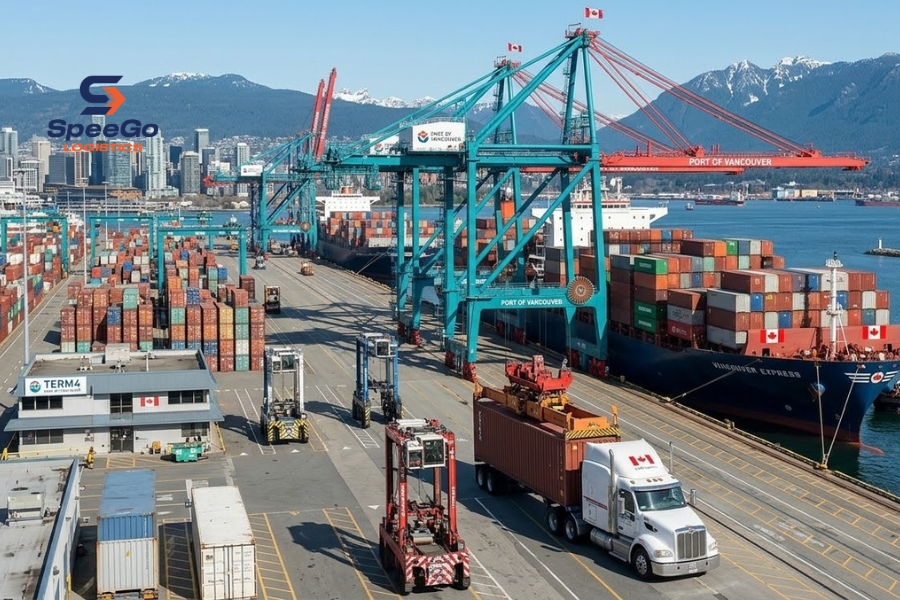
3.1. Port of Vancouver
The Port of Vancouver is the largest and busiest container port in Canada, making it a primary gateway for businesses shipping from Vietnam to Canada. Its strategic location on the West Coast allows vessels from Asia, including Vietnam, to reach Canada faster compared to East Coast routes. This directly helps reduce overall Canada shipping time, especially for businesses that prioritize speed and consistent delivery schedules.
- Province: British Columbia.
- Cargo Volume: 5 million tonnes.
- Containers Handled: 13 million.
- Facilities: 29 terminals.
Advantages of the Port of Vancouver
- Strong intermodal connectivity: The port is well connected to Canada’s national rail systems, including Canadian National (CN) and Canadian Pacific (CP). This makes it easier to transport goods inland to key markets such as Toronto, Calgary, and Montreal, especially for high-volume shipments.
- High capacity and frequent vessel schedules: According to the Vancouver Fraser Port Authority, the port handled over 3.5 million TEUs in 2023, confirming its position as Canada’s largest container hub. This scale allows for frequent sailings, giving businesses more flexibility and reducing waiting times between shipments.
- Suitable for large-scale imports: With its infrastructure and handling capacity, Vancouver is particularly well-suited for companies importing goods in large volumes or managing long-term supply chains.
Disadvantages of the Port of Vancouver
- Risk of congestion during peak seasons: Due to its high volume, the port can experience congestion during busy periods leading to delays in unloading, customs clearance, and inland transportation.
- Potential increase in logistics costs: Delays caused by congestion can result in additional costs such as storage fees, demurrage, or extended handling time, which may impact overall Canada shipping costs.
- Requires careful shipment planning: To fully benefit from the port’s advantages, businesses need to plan ahead, especially during peak seasons, to avoid disruptions and maintain supply chain efficiency.
3.2. Port of Montreal
The Port of Montreal plays a central role for businesses looking to import from Vietnam, particularly those targeting Quebec, Ontario, and the broader Central Canada region. Unlike West Coast ports, Montreal is located inland along the St. Lawrence River, which allows it to serve as a direct gateway to major consumption markets without requiring long inland rail transport.
- Province: Quebec.
- Cargo Volume: 4 million tonnes.
- Containers Handled: 54 million.
- Facilities: 23 terminals.
Advantages of the Port of Montreal
- Cost efficiency: When businesses deliver goods to cities like Toronto or Montreal, this port can help reduce overall Canada shipping costs.
- Strategic access to major consumer markets: The port handles around 1.5 million TEUs annually, making it the largest container port in Eastern Canada and a key logistics hub connected to over 140 countries. Its rail and trucking network enables cargo to reach more than 110 million consumers across Canada and the U.S. Midwest within two days.
- Inland connectivity: Strong intermodal infrastructure allows goods to move efficiently from the port to inland destinations, supporting businesses that prioritize stable and cost-effective distribution networks.
Disadvantages of the Port of Montreal
- Longer transit time from Vietnam: Compared to West Coast ports, shipments to Montreal typically take 30 – 45 days, as they often route through the Panama Canal or require transshipment. This can increase overall Canada shipping time, especially for businesses needing faster inventory turnover.
- Seasonal weather impact: Winter conditions in Eastern Canada can affect port operations, including navigation schedules and cargo handling efficiency. This adds a level of unpredictability during certain times of the year.
- Operational disruptions risk: Past labor disruptions have occasionally impacted port performance. While not constant, this highlights the importance of building buffer time into shipping plans.
3.3. Port of Prince Rupert
The Port of Prince Rupert has rapidly emerged as one of the most efficient gateways for businesses shipping from Vietnam to Canada, particularly for those prioritizing speed and reliability. Located on the northern coast of British Columbia, this port benefits from a shorter sailing distance from Asia compared to other Canadian ports, which can help reduce overall Canada shipping time by several days.
- Province: British Columbia.
- Cargo Volume: 6 million tonnes.
- Containers Handled: 700,000.
- Facilities: 6 terminals.
Advantages of the Port of Montreal
- High operational efficiency: The port is built with a strong focus on container throughput and consistently ranks among the top North American ports for low dwell time. According to the Prince Rupert Port Authority, it handles over 1 million TEUs annually, with faster container turnaround compared to larger ports. This helps reduce delays and improve reliability when shipping to Canada.
- Low congestion levels: Compared to major hubs like Vancouver, Prince Rupert experiences fewer bottlenecks, even during peak seasons. This allows businesses to maintain more predictable delivery schedules and avoid additional costs such as demurrage or storage.
Disadvantages of the Port of Prince Rupert
- Lower capacity compared to major ports: Although highly efficient, its overall handling capacity is smaller than that of larger ports such as Vancouver, which may limit scalability for very high-volume shipments.
- Fewer shipping routes and sailing frequency: Compared to larger ports, Prince Rupert typically offers fewer direct shipping services, which can restrict scheduling flexibility depending on the carrier and route.
3.4. Port of Halifax
The Port of Halifax is considered one of the most dependable deep-water ports along Canada’s East Coast, making it an ideal choice for companies shipping goods from Vietnam to Canada. Unlike certain larger ports, Halifax benefits from lower congestion, which facilitates more predictable vessel arrivals and smoother cargo operations.
- Province: Nova Scotia.
- Cargo Volume: 8 million tonnes.
- Containers Handled: 550,000.
- Facilities: 4 terminals.
Advantages of the Port of Halifax
- Stable operations: With an annual throughput of over 600,000 TEUs, the port operates at a smaller scale than major hubs like Vancouver.
- Strategic access to Eastern Canada: Halifax is well positioned for distribution to regions such as Nova Scotia, Quebec, and even Ontario. For importers targeting Eastern markets, this can reduce inland transportation distances and help balance overall Canada shipping costs.
Disadvantages of the Port of Halifax
- Longer transit time from Vietnam: Shipments to Halifax typically take longer than those to West Coast ports, as they often require routing through the Panama Canal or transshipment hubs.
- Fewer direct shipping options: Due to its smaller scale, the port may offer fewer direct shipping routes and sailing frequencies.
3.5. Port of Saint John
The Port of Saint John is an emerging container port on Canada’s East Coast that has been gaining attention among businesses looking for alternative entry points when shipping from Vietnam to Canada. While it is not as large as ports like Vancouver or Montreal, its ongoing expansion and improving infrastructure make it an increasingly practical option for importers seeking flexibility and cost control.
- Province: New Brunswick.
- Cargo Volume: 8 million tonnes.
- Containers Handled: 150,000.
- Facilities: Several smaller terminals.
Advantages of the Port of Saint John
- Competitive cost: Compared to larger and more congested ports, local handling fees and operational expenses are often more competitive. This can help businesses reduce overall Canada shipping costs, particularly when focusing on total landed cost rather than just ocean freight rates.
- Access to Eastern Canada and U.S. Northeast: Strategically located, Saint John offers convenient access to Eastern Canada and parts of the U.S. Northeast. For businesses distributing goods within these regions, the port can help reduce inland transportation distances compared to West Coast options.
Disadvantages of the Port of Saint John
- Longer transit: Similar to other East Coast ports, shipments from Vietnam typically take longer due to routing via the Panama Canal or transshipment hubs.
- Smaller scale compared to major ports: While capacity is improving, Saint John still operates at a smaller scale than major ports like Vancouver.
4. West Coast vs East Coast: Which Should You Choose?
When evaluating shipping from Vietnam to Canada, one of the most important strategic decisions is choosing between West Coast and East Coast ports. This choice directly affects both Canada shipping time and overall logistics efficiency.
| West Coast (Vancouver, Prince Rupert) | East Coast (Montreal, Halifax) | |
| Transit Time | 18 – 30 days from Vietnam | 30 – 45 days (via Panama Canal or transshipment) |
| Shipping Time | Shorter, suitable for urgent or fast-moving goods | Longer, requires better inventory planning |
| Inland Transport | Higher cost for central/eastern regions (rail/truck required) | Lower cost for Ontario, Quebec, Eastern Canada |
| Best For Location | Western Canada (BC, Alberta) | Central & Eastern Canada (Ontario, Quebec) |
5. Cost Breakdown by Port Choice
Different product categories come with different cost structures. Many items featured in the top 10 Canada import from Vietnam, such as textiles or wooden furniture, can significantly impact container utilization, packaging strategy, and overall Canada shipping costs.
| Description | Key Consideration | Estimated Cost Range | |
| Ocean Freight | Cost of sea transport from Vietnam to Canadian ports | Influenced by season, container type (FCL/LCL), and fuel rates | $1,500 – $4,000 + per container |
| Port Handling Charges | Terminal handling, documentation, and local port fees | Larger ports may have higher peak surcharges | $100 – $500 per shipment |
| Inland Transportation | Rail or truck delivery from port to final destination | Distance significantly impacts cost | $1,000 – $3,500 + per shipment |
| Storage & Demurrage | Fees for container storage or delays at port | Delays in pickup or customs clearance increase costs | $50 – $200 per day |
| Total Landed Cost | Combined cost of product, shipping, duties, and inland logistics | Should be calculated end-to-end, not based on freight alone | Varies depending on strategy and volume |
6. Tips to Optimize Shipping Costs from Vietnam to Canada
- Choose the Right Port Based on Final Destination: One of the most effective ways to control Canada shipping costs is to select the port based on where your goods will ultimately be delivered.
- Optimize Packaging to Reduce Volume (CBM): Since ocean freight is typically calculated based on volume (CBM), inefficient packaging can significantly increase expenses.
- Avoid peak shipping seasons: During high-demand periods, both freight rates and transit times tend to increase. Whenever possible, scheduling shipments during off-peak seasons can lead to more competitive pricing and smoother operations.
- Book shipments in advance: Sea freight is generally the most cost-effective option, but it also involves longer transit times. Planning and booking early can help secure better rates while reducing the risk of unexpected delays.
- Prepare documentation carefully: Well-prepared paperwork can help prevent delays and ensure a faster, more efficient import process.
- Understand HS codes and duties: Having a clear understanding of HS code classification allows businesses to estimate expenses more accurately and avoid unexpected charges.
7. SpeeGo Logistics – Your Trusted Partner for Sourcing and Shipping from Vietnam to Canada
Choosing the right strategy for import to Canada goes beyond comparing freight rates or supplier prices. It requires a clear understanding of ports, transit times, cost structures, and supplier reliability. This is where working with an integrated partner like SpeeGo Logistics can make a meaningful difference.
SpeeGo supports companies at every stage of the process, starting from choosing different suppliers for sourcing in Vietnam. Instead of spending weeks filtering through multiple Vietnam suppliers, businesses can rely on local expertise to identify reliable manufacturers that match their product requirements, pricing expectations, and export capabilities. This is particularly valuable for companies new to the market or those looking to scale sourcing efficiently.
SpeeGo helps evaluate product quality before shipment, ensuring that goods meet agreed specifications and reducing the risk of defects or returns. This step is essential not only for maintaining brand reputation but also for avoiding unnecessary costs that may arise during shipping to Canada, especially with fragile or high-volume goods.
On the logistics side, SpeeGo provides end-to-end support for shipping from Vietnam to Canada, including route planning, documentation, and coordination with carriers. By optimizing shipping methods and port selection, businesses can better manage both Canada shipping time and overall logistics efficiency. This becomes increasingly important when balancing transit speed with cost, particularly for companies importing at scale.
Sign up with SpeeGo Logistics today to optimize your importing and shipping operations from Vietnam to Canada.
Frequently Asked Questions (FAQ)
- Which is the best port for shipping from Vietnam to Canada?
There is no single “best” port for all businesses. The right choice depends on your final destination, delivery timeline, and cost priorities. West Coast ports like Vancouver are faster, while East Coast ports such as Montreal or Halifax may help reduce inland transportation costs when you import to Canada.
- Is it cheaper to ship to Canada via the West Coast or East Coast?
Not always. While ocean freight costs are often similar, total Canada shipping costs depend heavily on inland transportation.
- What factors should I consider when choosing a port in Canada?
- Final delivery location
- Inland transportation distance
- Port congestion and delays
- Shipping route frequency
- Total landed cost (not just freight rate)
- What is the biggest hidden cost when shipping to Canada?
Inland transportation is often the most overlooked cost. Moving goods from ports like Vancouver to cities such as Toronto can significantly increase total expenses, sometimes more than the ocean freight itself.