Import from China remains one of the most effective strategies for businesses looking to reduce costs and scale production. However, the process has become more complex due to changes in compliance, pricing structures, and global logistics. This guide will walk you through how businesses approach sourcing, evaluate suppliers, and manage shipping and import requirements effectively.
1. Why China Remains a Top Choice When You Import from China?
The appeal of sourcing from China goes far beyond pricing. What often stands out after a few sourcing cycles is how interconnected the entire manufacturing system is. Raw materials, components, production, and even packaging can all be handled within the same ecosystem, making coordination much smoother and timelines easier to control.
1.1. The Difference between China and Other Markets
China continues to rank highly in global manufacturing and logistics performance, supported by its infrastructure and production capacity. China’s strength comes from its industrial clusters, where suppliers, material providers, and service partners operate side by side. This setup reduces the need for back-and-forth coordination and helps streamline production.
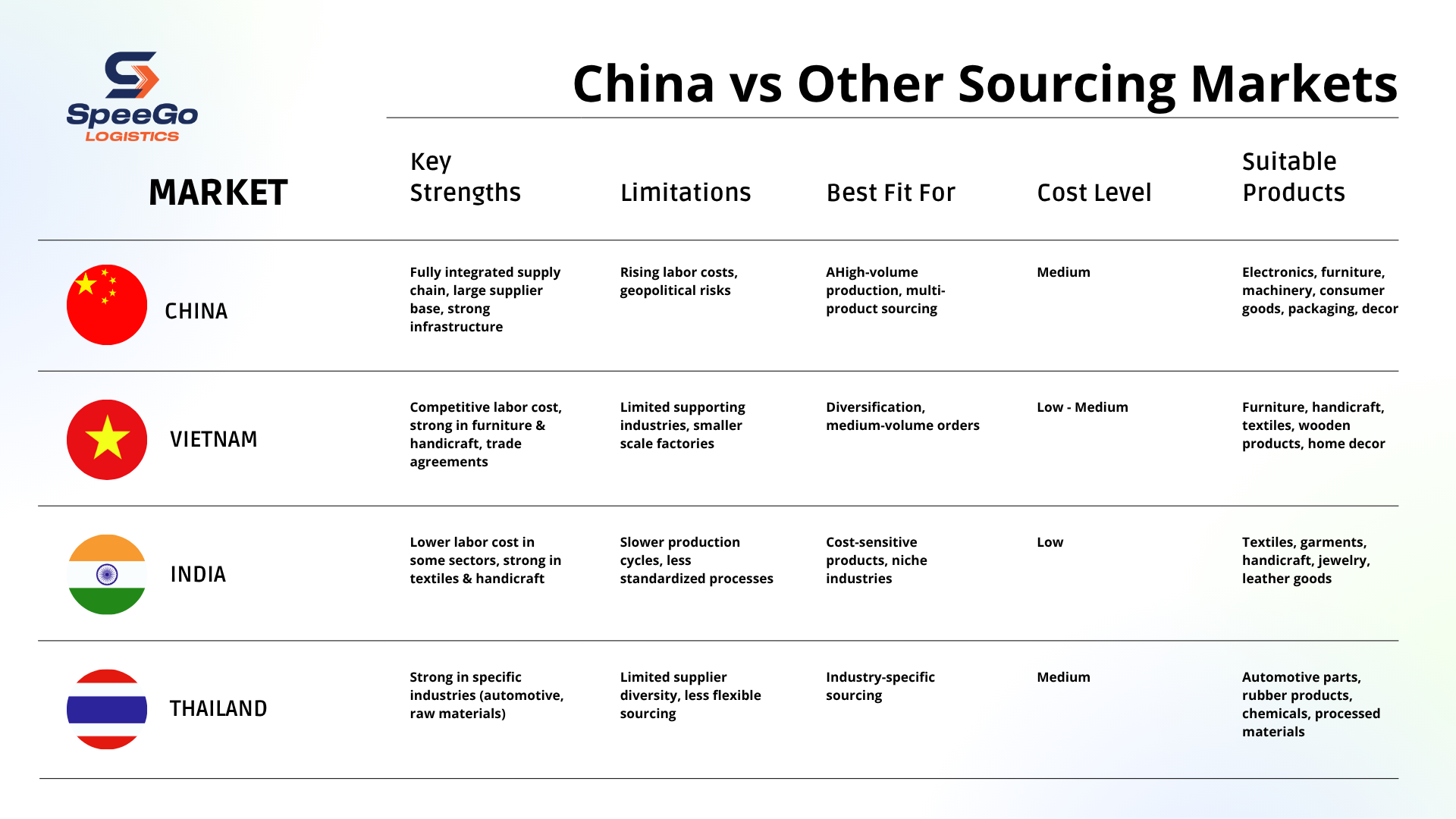
China vs Other Sourcing Markets (Summary)
- China: Best for high-volume manufacturing and multi-product sourcing due to its integrated supply chain
- Vietnam: Ideal for furniture, handicraft, and mid-volume production
- India: Suitable for low-cost, niche products like textiles and handmade goods
- Thailand: Strong in specific industries such as automotive and raw materials
1.2. Guidelines for Deciding When to Import from China
Choosing the right sourcing market isn’t a one-size-fits-all decision. China still offers clear strengths in scale and efficiency, but that doesn’t mean it’s the best fit for every product or business. You should take the time to understand where China works well and where it doesn’t so it can help you avoid costly mistakes early on.
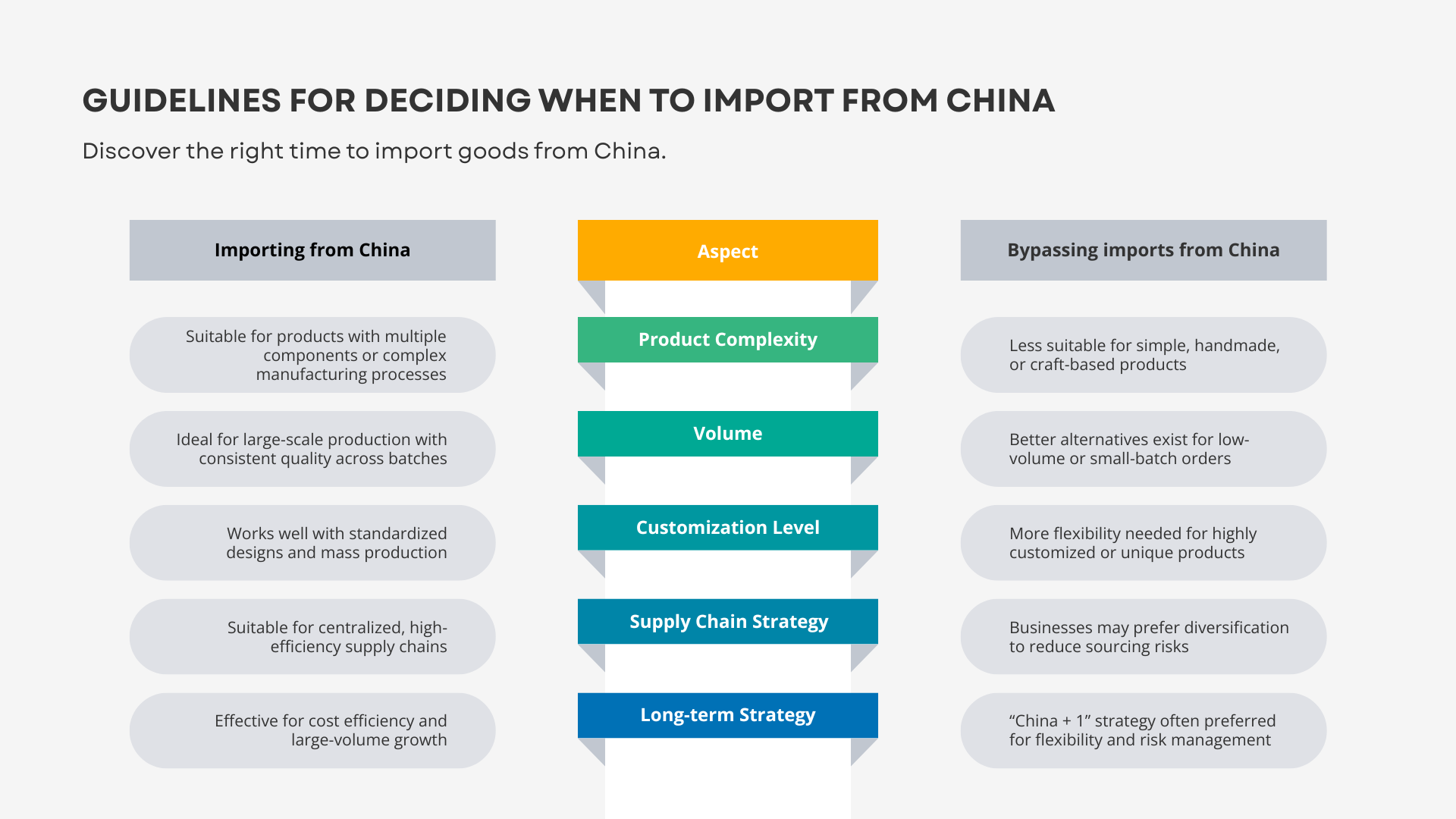
Key Factors to Decide When to Import from China
1. Product Complexity
Importing from China is ideal for products with complex manufacturing processes or multiple components. The country’s integrated supply chain makes it easier to coordinate production at scale. However, for simple or handmade products, alternative sourcing markets may offer more flexibility.
2. Order Volume
China is best suited for large-scale production with consistent quality across batches.
For smaller orders or low-volume testing, businesses may face higher MOQs and less flexibility, making other sourcing options more practical.
3. Customization Level
Standardized products and mass production are where China performs best.
If your business requires highly customized or unique designs, you may need suppliers that offer more flexibility outside of China.
4. Supply Chain Strategy
China works well for centralized, high-efficiency supply chains.
However, many businesses now adopt a diversification strategy to reduce risks, especially after recent global disruptions.
5. Long-term Strategy
Importing from China is highly effective for cost efficiency and long-term scaling.
At the same time, many companies are shifting toward a “China +1” strategy to balance cost, flexibility, and supply chain resilience.
2. What You Need to Prepare Before You Import from China?
If you’re new to importing, you’re probably eager to start searching for suppliers right away. It feels like you’re getting somewhere, but honestly, most headaches later like confusing prices, minimum order drama, or mismatched expectations. It usually happens because you skipped some key decisions upfront.
Taking the time to clarify these fundamentals early on will make the entire process of import from China far more predictable and easier to manage.
2.1. Product – Market Fit Comes First, Not the Supplier
Clarity around the product matters more than the number of suppliers you contact. A product that looks promising on paper may not perform well once shipping costs, competition, and positioning are factored in.
Ask yourself:
- Is the product price-competitive after shipping and duties?
- Does it require compliance or certifications in your target market?
- Can it be differentiated (design, packaging, branding), or is it purely price-driven?
China offers a wide range of manufacturing capabilities, but not every product benefits equally from that ecosystem. High-volume, standardized items tend to perform better because they align with China’s strength in scale.
2.2. Budget Planning
The supplier’s initial price per unit? That’s just the tip of the iceberg. A lot of folks underestimate all the extra costs.
A real budget needs to cover:
- Product cost (EXW or FOB)
- International shipping
- Import duties and taxes
- Inland transportation
- Packaging and handling
- Buffer for defects or delays
If a product that costs $2 per unit may end up closer to $3.50 – $4 after logistics and duties. Without this visibility, it becomes difficult to price competitively or maintain margins when you import from China.
2.3. Choosing the Right Business Model
Not all sourcing approaches lead to the same outcome. The model you choose will shape everything from supplier selection to pricing structure.
- Wholesale: Buying ready-made products in bulk. Faster to start, lower development cost, but limited differentiation.
- Private label: Adding your own branding to existing products. Offers a balance between speed and customization. Common in cosmetics, home goods, and decor.
- ODM (Original Design Manufacturing): Developing custom products based on your own specifications. Higher upfront cost and longer lead time, but stronger brand control.
Each model comes with trade-offs. Wholesale may work for testing the market, while private label or ODM becomes more relevant when building a long-term brand through sourcing from China.
3. Type of sourcing in China
Once you start exploring sourcing from China, one thing becomes obvious quite quickly that there is no shortage of suppliers. The real challenge is not finding options, but figuring out which ones are actually worth your time.
Not every “supplier” plays the same role. Knowing the difference helps avoid misaligned expectations from the start.
- Factory (Manufacturer): This is the direct producer. Working with factories usually gives you better pricing and more control over customization. However, communication may not always be smooth, especially if they are focused more on production than international clients.
- Trading Company: These companies act as intermediaries. They don’t manufacture products themselves but source from multiple factories. Pricing is typically higher, but communication is often easier, and they can offer a wider product range.
- Sourcing Agent: A sourcing agent works on your behalf. They help identify suppliers, negotiate pricing, manage quality control, and coordinate logistics. This option is especially useful when you are new to importing from China or managing multiple product lines.
Each option has its place. Factories are suitable for scaling, trading companies work well for mixed sourcing, and agents help reduce complexity when local expertise is needed.
4. Understanding Pricing When You Import from China
Pricing is often where expectations and reality start to diverge when import from China. The first quote may look straightforward, but it rarely reflects the full cost of getting your product delivered and ready for sale. A clearer understanding of pricing structure at this stage can prevent margin issues later on.
Most suppliers will quote using standard trade terms such as EXW, FOB, or CIF, and each one shifts responsibility differently between buyer and seller. EXW usually offers the lowest upfront price but requires you to manage the entire logistics process. CIF, on the other hand, includes shipping but often lacks transparency in cost breakdown. Many importers prefer FOB because it provides a balance between control and convenience. These terms are standardized under Incoterms by the International Chamber of Commerce, which helps define responsibilities clearly in international trade.
A lower quote does not always mean better value. In many cases, pricing that seems significantly cheaper is tied to compromises in materials, production processes, or quality control. These differences are not always visible at the quotation stage but tend to appear after delivery, leading to higher defect rates or inconsistent product quality. Additional costs also come into play beyond the unit price, including packaging for export, inspection fees, tooling costs for custom products, and various port or documentation charges. Logistics-related expenses can account for a substantial share of total trade costs, which explains why the initial quote rarely reflects the full financial picture when you import from China.
A more reliable way to evaluate pricing is to compare suppliers on a like-for-like basis. Using the same Incoterm, confirming identical product specifications, and breaking down each cost component can make comparisons much clearer. Instead of focusing only on unit price, it is more useful to estimate the landed cost, which includes shipping, duties, and local delivery. This approach provides a more realistic view of profitability and helps avoid surprises later. Over time, consistency in pricing and quality tends to matter more than chasing the lowest possible quote, especially when scaling operations through long-term sourcing from China strategies.
What Is the Real Cost to Import from China?
For many entrepreneurs, the biggest question is not how to import from China, but whether it is the right model to start with. Small businesses often face limitations in budget, order quantity, and logistics experience. Importing smaller quantities through LCL shipping or working with flexible suppliers can help reduce upfront investment. Many small businesses start with private label products to test demand before scaling into larger orders.
Understanding how to import from China for small business scenarios allows you to manage risks while building a more sustainable supply chain.
5. Key Documents Required to Import from China
Paperwork rarely gets much attention at the beginning, but it is often the difference between a smooth shipment and unexpected delays at customs. Even a small mismatch in documents can hold your cargo for days or trigger additional inspections. Below are the key documents you will encounter when sourcing from China, along with their purpose and requirements:
- Commercial Invoice: The main financial document issued by the supplier, showing the value of goods sold. It’s must include accurate product description, HS code, unit price, total value, Incoterms (EXW, FOB, etc.), and buyer/seller details. Values must reflect the actual transaction to avoid customs penalties.
- Packing List: A detailed breakdown of how goods are packed for shipment. This document includes quantity, carton numbers, dimensions, gross/net weight. Must match the commercial invoice and physical shipment to support customs inspection.
- Bill of Lading (B/L) (for ocean freight): A transport document issued by the carrier confirming goods have been loaded onto a vessel. It also serves as a document of title. Paper must show shipper, consignee, port of loading/discharge, and cargo details. Errors can delay cargo release at destination.
- Air Waybill (AWB) (for air freight): The air freight equivalent of a B/L, used for tracking and handling shipments, include correct routing, cargo details, and consignee information. Unlike B/L, it is non-negotiable (does not transfer ownership).
- Certificate of Origin (CO): A document certifying the country where the goods were manufactured.
- Import License (if applicable): A permit required by certain countries for restricted or regulated goods. Depends on product category (e.g., cosmetics, chemicals, electronics). Importers must verify requirements before shipment.
- Inspection Certificate (Quality Control Report): A document issued by a third-party inspection company confirming product quality and specifications.
- Insurance Certificate: Proof that the shipment is insured against loss or damage during transit.
- Requirements: Typically required under CIF terms or when cargo insurance is purchased separately.
6. Import Taxes, Duties, and Tariffs When Importing from China
6.1. China Export Restrictions
While most attention is placed on import duties, export controls from China can also impact your shipment. China’s Export Control Law (EC Law) regulates the export of certain sensitive goods, especially those related to national security or advanced technology.
Restricted product categories include:
- Military and defense-related goods
- Nuclear-related materials
- Dual-use items (civilian and military applications)
Controlled technologies (license required):
- Telemetry coding and encryption software/hardware
- Artificial intelligence technologies
- Cryptography and cybersecurity tools
- Advanced defense-related technologies
China’s Export Prohibited and Restricted Technology Catalog currently lists dozens of controlled technologies that require licensing before export. This is particularly relevant if you are sourcing electronics, software-related products, or high-tech components. If businesses are looking for suitable products, you can refer to China’s top 10 export products.
6.2. Key Import Taxes and Charges
Since 2025, China has tightened its export control framework under Announcement 17/2025. This regulation effectively ended the long-standing “buy export” practice, where factories without export licenses relied on third parties to handle customs declarations. Under the new rules, only companies officially registered with Chinese tax authorities are allowed to export goods. Each shipment must be declared using the exporter’s own license, and importantly, that exporter must be the actual legal owner of the goods.
In addition, businesses must also thoroughly understand China’s tariffs. While export tariffs from China are generally limited to specific categories (such as certain raw materials or controlled goods), they can still affect supplier pricing and overall sourcing strategy. More importantly, these export-side considerations are closely linked to how import tax is calculated in the destination country. Customs authorities rely on accurate declared values, HS codes, and exporter information to assess duties. Any mismatch between export documents and import declarations can lead to revaluation, higher duty rates, or delays in clearance.
6.3. Import Regulations by Market (USA, Canada, and Australia)
When planning to import from China, requirements can vary significantly depending on your destination market.
- United States: Importers must comply with regulations from agencies such as the FDA, FCC, or CPSC depending on product type. Import duties are calculated based on HS codes and declared value.
- Canada: labeling requirements are stricter, especially for consumer goods, which often require bilingual packaging (English and French). Additional compliance checks may apply to cosmetics, textiles, and food-related products.
- Australia: Biosecurity regulations are particularly strict. Products made from natural materials such as wood or bamboo may require inspection or treatment before entry.
Understanding these differences is essential when you import from China to USA, Canada, or Australia, as non-compliance can lead to delays or additional costs.
7. Get started with SpeeGo Logistics
Getting started with your first import from China shipment can feel overwhelming at first, especially when multiple factors like supplier selection, pricing, documentation, and import tax all come into play at the same time. Having the right partner makes a noticeable difference, not just in execution, but in avoiding costly mistakes early on.
SpeeGo Logistics supports businesses throughout the entire process, from identifying reliable suppliers to managing shipping and ensuring compliance with import requirements. Whether you are testing a new product or scaling an existing supply chain, the goal is to help you move from uncertainty to a more structured and predictable importing process.
If you’re looking to simplify your journey and gain better control over costs, timelines, and supplier quality, SpeeGo is ready to support your next step.
Start your import and shipping journey with SpeeGo Logistics today
Frequently Asked Questions (FAQ)
- What is the easiest way to start import from China?
Starting with a clear product plan is more important than contacting suppliers immediately. Define your product specifications, target price, and estimated order volume first. This helps you filter suppliers more effectively and avoid miscommunication when importing from China.
- What are common mistakes when import from China?
Some of the most common issues include:
- Choosing suppliers based on price alone
- Underestimating shipping and import tax costs
- Skipping quality inspection
- Not verifying supplier export compliance
These mistakes often lead to delays, defects, or unexpected expenses.
- Do I need a import agent to import from China?
Not always, but it can be helpful if you:
- Are new to import from China?
- Manage multiple suppliers
- Need support with negotiation, inspection, and logistics
A import agent can simplify the process and reduce operational risks.