The trend of exporting cosmetics from China has been growing rapidly in recent years, especially in OEM/ODM and private label models. Many international brands from the US, Australia, and Canada choose manufacturers in China. However, the process of importing cosmetics from China is more complex than many people realize. Therefore, businesses need to thoroughly understand the procedures, prepare the necessary documentation, and select the appropriate international shipping methods.
To address business concerns, SpeeGo Logistics has compiled essential information that companies should know before exporting cosmetics from China to their target markets.
1. Why do Vietnamese businesses in the US, Australia, and Canada choose to import cosmetics from China?
In recent years, China has not only become a massive consumer market but also one of the largest cosmetic manufacturing hubs worldwide. This creates clear advantages for Vietnamese companies when sourcing products for distribution, brand development, or private label manufacturing.
1.1. Large-scale OEM/ODM models
China’s cosmetic manufacturing industry is diverse and robust. According to the latest report from the National Medical Products Administration (NMPA), over 5,500 Chinese companies held cosmetic manufacturing licenses in 2023. Among them, more than 300 had annual outputs exceeding 1 billion RMB. Most factories are concentrated in regions with advanced infrastructure and logistics, such as Guangdong, Zhejiang, Shanghai, and Jiangsu.
1.2. Competitive costs
It’s no coincidence that many international cosmetic brands choose to establish manufacturing in China. Data from the Industry Report on China’s Cosmetics and Skincare Industry shows that China’s cosmetics market has expanded significantly from about 531.1 billion RMB in 2019 to approximately 688.6 billion RMB in 2024, with an average annual growth rate of over 7%.
One of China’s main attractions is its cost competitiveness compared to markets like South Korea, Japan, or Europe. The abundant labor force helps keep raw material costs, wages, and manufacturing services significantly lower than in many developed countries. This is a key reason why many companies select China for cosmetic production, especially when balancing quality and cost.
1.3. Rich raw material ecosystem
In addition to its large manufacturing scale, many Chinese cosmetic factories have adopted digital technologies and automation to improve efficiency and product consistency. Some facilities even integrate market trend analysis and internal R&D to shorten the time-to-market for new products, providing businesses with greater flexibility in product development strategies.
2. Understanding Legal Requirements in Import Markets
Before selecting a manufacturer or placing orders, businesses must thoroughly understand the legal regulations of their target markets. Each country has its own cosmetic management system. Failing to research these regulations early can result in products being detained at customs, rejected documentation, fines, or even product recalls.
2.1. United States – Strict regulations by the FDA and CBP
In the US, cosmetics are considered consumer products but must comply with federal regulations managed by the Food and Drug Administration (FDA) and Customs and Border Protection (CBP). The FDA defines cosmetics as products used for cleaning, beautifying, or altering the appearance of the body. If a product has therapeutic functions, such as treating acne or providing sun protection, it may be classified as a drug or medical device, requiring more rigorous approval.
Unlike many countries, the FDA does not require pre-market approval for cosmetics, except for certain colorants. However, products must be safe under normal use, and labels must be in English, clearly stating product identity, net quantity, manufacturer or distributor information, and an “Affirmation of Compliance” to facilitate customs clearance when shipping to USA.
2.2. Canada – Mandatory notification and compliance with banned substances
Canada regulates cosmetics under the Food and Drugs Act and the Cosmetic Regulations enforced by the Ministry of Health. Similar to the US, cosmetics are defined as products used to clean, improve, or change the appearance of the body, hair, or teeth, but must be notified to authorities within 10 days of sale.
Additionally, Canada maintains a “Hotlist”- a list of restricted or banned ingredients. If a product contains any listed substances, it may be suspended or required to be re-exported unless the ingredients are removed or replaced. Therefore, brands preparing for shipping to Canada must review ingredient compliance carefully before mass production to minimize regulatory risks.
2.3. Australia – Chemical management and clear classification under AICIS
Australia’s approach differs slightly: most cosmetic ingredients are considered “industrial chemicals” and are regulated under the Australian Industrial Chemicals Introduction Scheme (AICIS) according to the Industrial Chemicals Act 2019.
Businesses must ensure that ingredients are permitted and correctly classified according to risk categories, which determine the required documentation and reporting obligations. For companies engaged in shipping to Australia, proper ingredient registration and compliance verification are critical steps before customs clearance. The Australian Competition and Consumer Commission (ACCC) monitors labeling and prevents false advertising, while the Therapeutic Goods Administration (TGA) oversees products with therapeutic claims, such as medicinal cosmetics.
3. Legal Conditions and How to Choose Compliant Chinese Cosmetic Manufacturers
Once the legal requirements of the import market are clear, the next critical step is selecting the right manufacturer. Most import risks stem not from shipping but from non-compliant legal documentation or factories lacking proper manufacturing qualifications.
3.1. Finding suppliers
Locating factories in China is relatively straightforward, but verifying their compliance with US (FDA/MoCRA), Canadian (Health Canada), and Australian (AICIS) standards is more challenging.
Common sourcing channels:
– Alibaba: Use filters like “Verified Supplier” and “Gold Supplier.” Avoid new accounts with limited transaction history.
– Made-in-China.com: A B2B platform focused on export factories.
– Cosmoprof exhibitions: Major international cosmetics trade shows featuring reputable OEM/ODM factories.
– Recommendations from sourcing experts or experienced logistics providers are also valuable.
3.2. Essential verification criteria before ordering
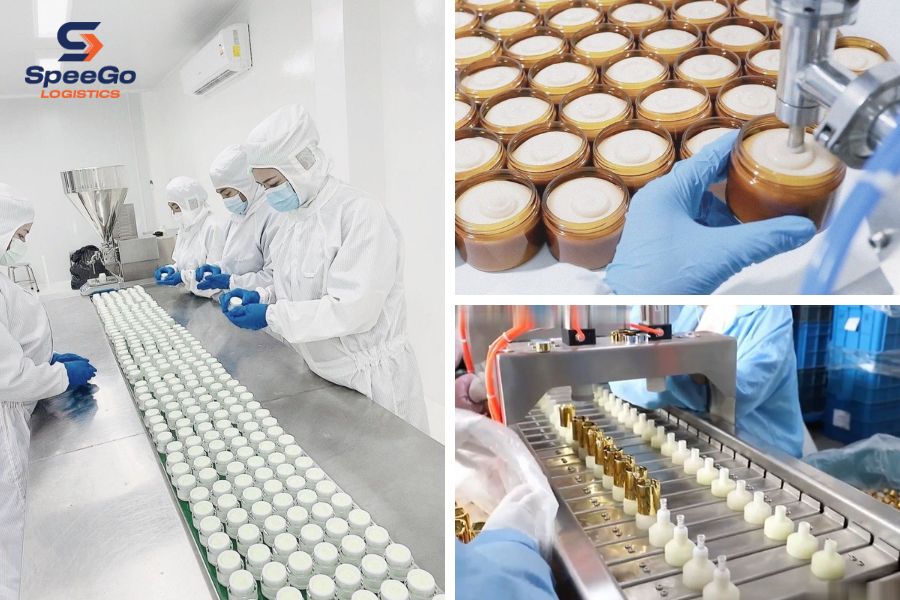
– GMP, ISO 22716, or FDA compliance certificates: Factories should adhere to Good Manufacturing Practices (GMP) and ISO 22716 standards specific to cosmetics.
– Availability of complete legal documents:Such as CFS, LOA, COA, MSDS, INCI ingredient lists, and formulation records. Missing or invalid certificates are common reasons for rejection or additional requests.
– Export experience: Confirm whether the factory has previously exported to the US, Canada, or Australia, and whether they can provide relevant documentation for these markets.
– Factory size and MOQ: For new entrants, factories with high MOQs can create financial and inventory pressures. Balance production capacity, budget, and initial market testing strategies.
4. Sample Product Requirements and Testing
Before confirming large-scale production, companies must request samples and conduct quality inspections. Samples help verify the actual product received, not just images or lab reports. This step is crucial in navigating strict markets like the US, Canada, and Australia, where safety standards and consumer feedback are highly rigorous.
When inspecting samples, consider:
– Product texture: Stable, smooth, and as described, without dryness, greasiness, or separation.
– Fragrance and spreadability: Pleasant, non-overpowering scents, and easy application with even color payoff.
– Durability on skin: Resistance to smudging, oxidation, and fading over hours.
– Skin reactions: Testing on various skin types to identify potential irritations or allergic responses under different temperature and humidity conditions.
5. Confirm Full Legal Documentation and Product Safety
Once samples meet expectations, thoroughly review all legal and safety documents before placing official orders. Demonstrating compliance and safety is mandatory for smooth customs clearance and to minimize product recall risks.
Check the following:
– COA (Certificate of Analysis): Confirms parameters like pH, active ingredients, and quality standards per batch.
– MSDS (Material Safety Data Sheet): Provides safety instructions for handling and transportation.
– INCI list: Ensures proper labeling according to international standards and absence of restricted substances.
– GMP certification: Indicates manufacturing professionalism.
– Testing reports: Demonstrate product safety under various storage conditions.
6. Packaging Selection
In the cosmetics industry, packaging is vital not only for product protection but also for influencing consumer purchasing decisions, especially online. After completing legal and safety checks, focus shifts to packaging and branding.
Choose packaging suited to the product type, considering printing methods and surface finishing. Labels must be attractive yet compliant, including essential information such as product name, ingredients, and expiry date.
7. Finalize Pricing, MOQ, and Payment Terms
With formulas, packaging, and technical specifications approved, clarify all financial terms before signing contracts or making deposits. This step helps control costs, avoid hidden charges, and ensure smooth business operations.
7.1. Price analysis
Manufacturers should provide a detailed price list covering ingredients, primary and secondary packaging, labeling, and assembly costs. Some suppliers quote low base prices but charge extra for special finishes like hot stamping, UV coating, or shrink wrapping.
7.2. Clarify MOQ
MOQ should be specific per product, shade, or total order quantity. Some factories require a minimum of 1,000 units per product but may allow smaller quantities per color, such as 200 units. This affects the number of SKUs a new brand can launch initially. Opting for fewer variations can help save costs and reduce inventory risks.
7.3. Production timeline
Ask about sample lead time and bulk production duration. Typically, samples take 1 – 2 weeks, while large orders may require 30 – 60 days depending on order size and peak seasons. Planning ahead enables better scheduling for product launches, marketing campaigns, and logistics.
7.4. Payment terms
Most manufacturers require deposits before production begins commonly 30%. The remaining balance is paid before shipment. For first orders, follow secure payment procedures, verify bank details, and use reliable international transfer methods. After initial success, some factories may offer more flexible terms, but it’s advisable not to rely on this for the first transaction.
8. Customs Procedures Preparation
After production confirmation and shipping arrangements, businesses should prepare complete customs documents to avoid delays. Essential documentation includes commercial invoices, packing lists, purchase contracts, bills of lading/airway bills, and technical documents like COA or MSDS if needed.
Proper declaration of the HS code for each cosmetic product is critical, as it impacts import duties and inspection processes. Incorrect codes may cause detention, storage costs, and shipment delays. Ensure consistency in product descriptions, quantities, weights, and declared values across documents.
9. Quality Inspection Before Shipment
Before final payment and shipment confirmation, companies should conduct quality inspections. Instead of traveling to China or relying solely on factory reports, many prefer pre-shipment inspection services through logistics providers like SpeeGo Logistics. These inspections help prevent shipments of incorrect items, shortages, or packaging errors.
10. Cost and Import Duty Calculation
Many new businesses focus only on manufacturing costs, overlooking expenses such as shipping, taxes, and processing fees. This oversight can reduce actual profit margins or cause losses if pricing isn’t adjusted accordingly. Companies should account for:
– Product and packaging costs: Including formula, bottles, labels, printing, and factory service fees.
– International shipping costs: Vary based on method, with additional charges at destination (port fees, handling, customs clearance).
– Import duties and tariffs: Calculated based on HS codes and country-specific regulations, often as a percentage of the product’s value or per specific item group.
– Additional taxes: Such as VAT/GST, customs clearance fees, document processing, or import permits if required.