

If you are new to international shipping, you may wonder what does ex works price mean and why it appears so often in supplier quotations. At first glance, the price may seem attractive, but it comes with important responsibilities that every business should understand.
1. What Does Ex Works Price Mean?
The term “Ex Works” (EXW) is one of the standard rules defined under the International Chamber of Commerce Incoterms framework, which governs how responsibilities are shared between buyers and sellers in international transactions.
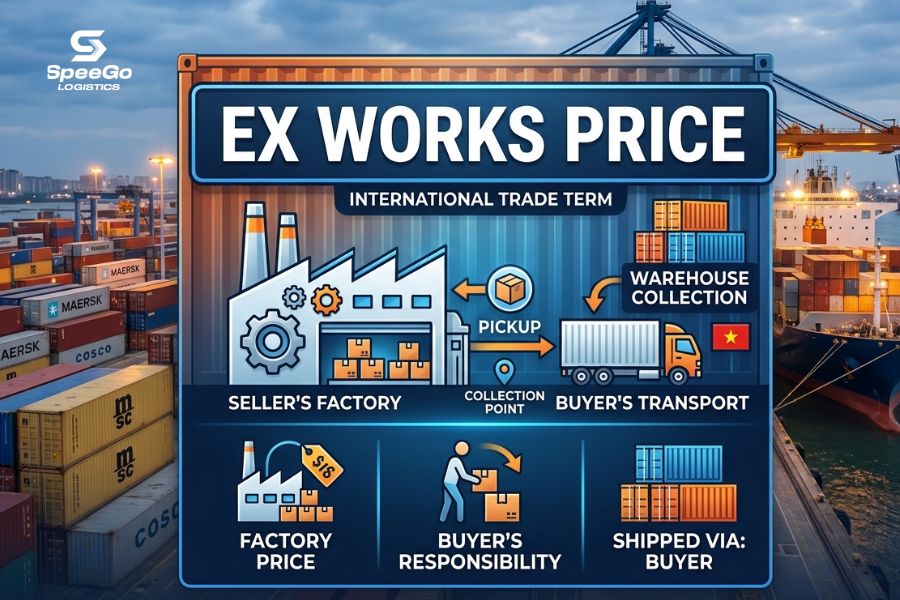
Ex works pricing refers to a pricing structure where the seller makes the goods available at their premises, such as a factory, warehouse, or workshop, and the buyer takes full responsibility from that point onward.
Under EXW, the seller’s obligation is minimal. They only need to prepare the goods and ensure they are ready for collection at the agreed location. Once the goods are made available, all further costs and risks shift to the buyer.
2. What Is Included in an Ex Works Price?
To fully understand what does ex works price mean, businesses need to look beyond the basic definition and examine the actual cost structure. One of the most common misunderstandings is assuming that an EXW price covers more than it actually does.
2.1. Costs Included in an Ex Works Price
The seller is only responsible for making the goods available at their premises. As a result, the EXW price typically includes:
- Product cost: The base value of the goods as agreed between the buyer and seller
- Basic packaging: Standard packaging required to prepare the goods for collection and transport
- Internal handling (at origin): Costs related to preparing and storing goods before pickup
These components reflect the ex works cost breakdown, which focuses only on activities within the seller’s control before the goods leave their facility.
2.2. Costs Not Included in an Ex Works Price
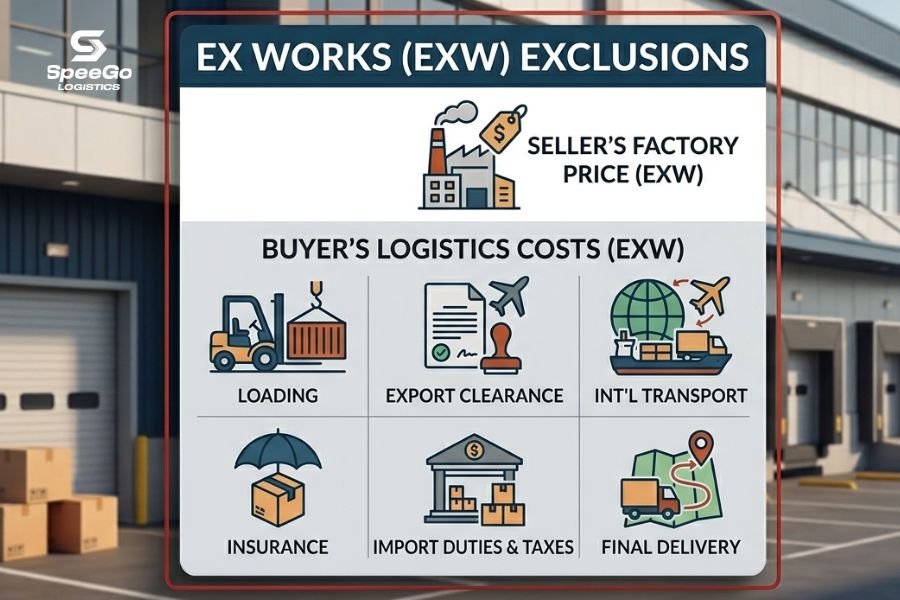
A key aspect of what does ex factory price mean is understanding what is excluded. Under EXW terms, almost all logistics-related costs fall on the buyer, including:
- Loading charges: The cost of loading goods onto the transport vehicle at the seller’s premises
- Export customs clearance: Documentation, export duties (if applicable), and compliance procedures
- International transportation: Freight costs for sea, air, or land transport
- Insurance:Coverage for goods during transit
- Import duties and taxes: Customs duties, VAT, and other charges in the destination country
- Final delivery costs: Transportation from the port or terminal to the final destination
EXW places the minimum obligation on the seller, which explains why most of these costs are not included in the initial price.
3. Buyer and Seller Responsibilities in Ex Works Price
To clearly understand what does ex works price mean, businesses must examine how responsibilities are divided between the buyer and the seller. Under EXW (Ex Works), this division is heavily weighted toward the buyer, making it one of the most demanding Incoterms for importers.
3.1. Seller Responsibilities
The seller’s role is limited and primarily focused on preparing the goods:
- Prepare the goods: Ensure that products meet the agreed specifications and are ready for delivery
- Packaging and labeling: Provide appropriate packaging for safe handling and identification
- Make goods available at premises: Place the goods at a designated location (factory, warehouse, or facility) for pickup
- Provide basic documentation: Issue commercial invoices or documents required to prove the sale
Importantly, the seller is not responsible for loading the goods onto the buyer’s transport vehicle unless otherwise agreed. This is a key detail that many businesses overlook.
3.2. Buyer Responsibilities
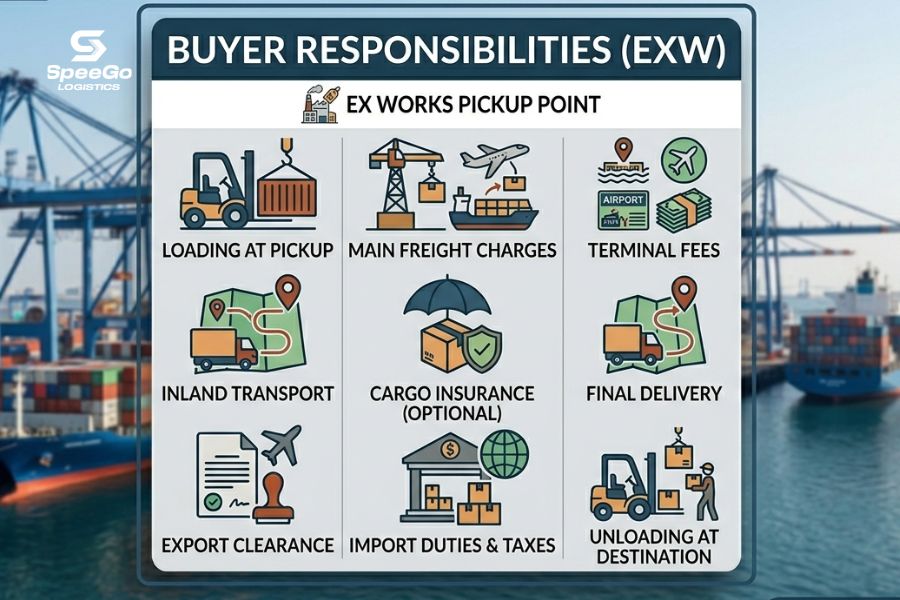
In contrast, buyer responsibility ex works covers almost every stage after the goods are made available:
- Loading at pickup location: The buyer is responsible for arranging and paying for loading the goods at the seller’s facility
- Inland transport to port of origin: Cover the cost of moving goods from the supplier’s location to the export port
- Export customs procedures: Handle all export-related documentation, duties, and regulatory requirements in the origin country
- Loading for international transport: Pay for placing the goods onto the main carrier, such as a vessel, aircraft, or truck
- Freight charges: Bear the cost of transporting goods between countries, depending on the chosen shipping method
- Cargo insurance (optional): Arrange and pay for insurance if protection against transit risks is required
- Import customs clearance: Manage import duties, taxes, and documentation upon arrival in the destination country
- Terminal handling fees: Pay any charges incurred at the arrival terminal, including handling and storage
- Final delivery to destination: Organise transport from the port of arrival to the final delivery point
- Unloading at destination: Cover the cost of unloading goods, including labour and equipment if needed
Handling all these steps under EXW can be complex without the right support. SpeeGo Logistics offers comprehensive sourcing and international shipping services, helping you connect with reliable suppliers while managing the entire logistics process from pickup to final delivery.
4. When Should Businesses Use Ex Works Pricing?
The next question for many businesses is whether EXW is the right choice for their specific situation. While Ex Works offers simplicity for sellers, it is not always suitable for every transaction, especially for buyers with limited logistics experience.
4.1. When Ex Works Is a Good Fit
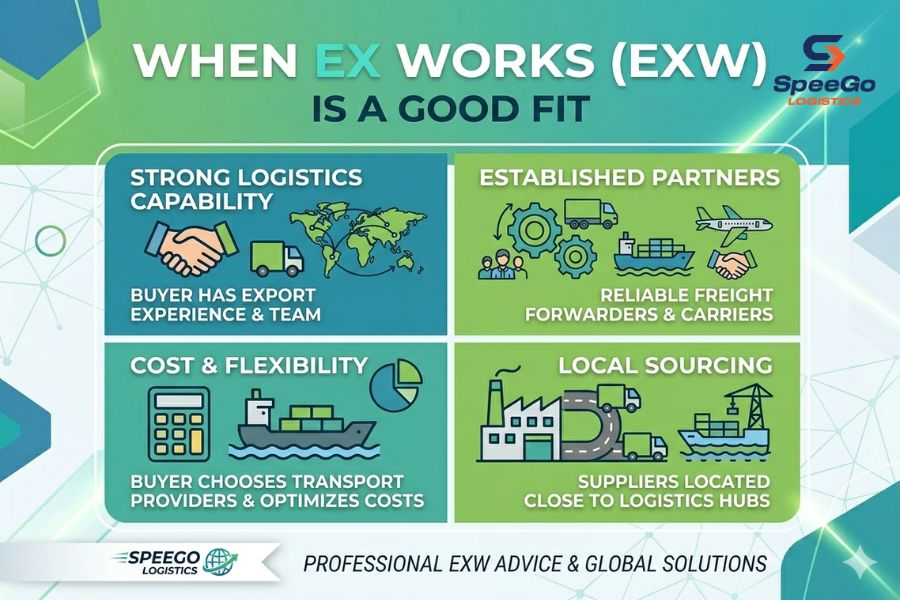
There are several scenarios where when to use ex works becomes a practical decision:
- Buyers with strong logistics capabilities: Companies that already have experience in international shipping, customs clearance, and freight management can benefit from full control over the supply chain
- Established relationships with logistics partners: Businesses working with reliable freight forwarders or carriers can handle EXW shipments more efficiently and reduce operational risks
- Cost control and flexibility: EXW allows buyers to choose their own transport providers and optimise costs based on preferred routes and shipping methods
- Local sourcing or nearby suppliers: When suppliers are located close to ports or logistics hubs, managing EXW shipments becomes more manageable and cost-effective
Managing EXW shipments becomes much easier when you have the right support in both sourcing and logistics. SpeeGo Logistics provides end-to-end solutions, from finding reliable suppliers to handling international shipping efficiently. With strong experience in supplier coordination, freight management, and global delivery, SpeeGo helps businesses take full advantage of EXW while reducing risks and operational complexity.
4.2. When Businesses Should Avoid EXW
Despite its advantages, EXW is not always the best option. Businesses should be cautious in the following situations:
- Limited logistics experience: Companies without knowledge of export procedures, customs regulations, or international shipping may face delays and unexpected costs
- Complex regulatory environments: In some countries, export clearance must legally be handled by the seller, making EXW difficult to apply in practice
- Lack of local presence: Buyers without a physical presence or agent in the origin country may struggle to coordinate pickup, documentation, and compliance
- High-risk or time-sensitive shipments: Without proper coordination, EXW shipments may face delays, which can affect delivery schedules and customer satisfaction
To sum up, what does ex works price mean is more than just a pricing term, it defines how responsibilities are divided between buyer and seller. A clear understanding of EXW allows businesses to plan shipping more accurately, control costs, and reduce operational risks in global trade.