

Understanding the basic element of handicraft is essential for businesses sourcing handmade products, especially when quality, cost, and scalability are critical. In this post, SpeeGo Logistic will explain 3 key factors of handicraft.
1. What are the basic elements of Handicraft?
The term basic element of handicraft is often explained in a theoretical way. In practice, especially when sourcing products, it refers to the core factors that determine whether a handicraft item can be produced consistently, meet quality expectations, and scale for commercial use. The basic elements of handicraft are the foundational components that shape how a product is made, how it looks, and how it performs in real use. These elements go beyond aesthetics. They influence durability, consistency, and the ability to reproduce the product across multiple batches.
According to UNESCO, handicrafts are defined by the combination of traditional skills, manual processes, and locally sourced materials, which reinforces the importance of understanding how these elements interact in real production. In handicraft manufacturing, the “elements” are not abstract ideas. They are visible in every stage of production:
- The material determines texture, durability, and cost stability
- The craftsmanship affects finishing quality and consistency
- The design defines both visual appeal and production complexity
These are commonly referred to as the 3 basic elements of handicrafts, and they form the foundation for evaluating any handmade product. At the core, each basic element of handicraft plays a direct role in determining whether a product can be consistently produced and scaled.
2. The 3 Basic Elements of Handicrafts
To better understand the basic element of handicraft, it is important to break it down into three core components: material, design, and technique. These are widely considered the 3 basic elements of handicrafts, and they directly influence not only how a product looks, but how it performs in production and in the market.
2.1. Material
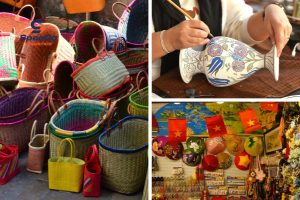
Material is the starting point of any product. Handicraft in Vietnam has common materials include bamboo, rattan, wood, ceramics, and lacquer. Each material behaves differently in terms of durability, flexibility, and consistency.
Natural Materials in Handicraft
- Bamboo: Lightweight, flexible, and fast-growing; commonly used for baskets, trays, and furniture frames
- Rattan: Stronger than bamboo, suitable for weaving furniture and storage products
- Seagrass: Soft fiber, often used for baskets, rugs, and home décor items
- Water hyacinth: Thicker fiber than seagrass; used for woven storage and furniture
- Wood (Acacia, Rubberwood, Pine, Oak): Used for furniture and decorative items; each type varies in density and finishing
- Coconut shell: Hard natural material used for bowls, utensils, and decorative pieces
- Shell (Mother of Pearl): Applied in inlay techniques, especially in lacquerware
- Stone (Marble, Limestone): Used for sculptures and home décor
- Clay (for ceramics): Base material for pottery and ceramic bowls
- Natural fibers (cotton, jute): Used in weaving, textiles, and soft handicraft products
You can read more about handicrafts from Vietnam: Top 10 Unique Handicraft Products to Import from Vietnam
Synthetic Materials in Handicraft
- Resin (Polyresin): Common in decorative items and statues; allows detailed shapes
- Composite materials: Mix of natural fibers and synthetic binders for improved strength
- Synthetic rattan (PE rattan): Designed for outdoor furniture or weather-resistant
- Engineered wood (MDF, plywood): Stable structure, often used in combination with veneer
- Plastic blends: Used in mass-produced decorative or functional items
- Metal (iron, aluminum, stainless steel): Often combined with handmade elements for structure
Traditional Materials used in Handicraft
- Ceramic clay: Fired at high temperatures for bowls, plates, vases
- Handwoven fibers: Traditional weaving techniques using bamboo strips, rattan, or natural fibers
- Silk: Used in textile handicrafts, embroidery, and decorative items
- Horn and bone: Applied in carving and inlay work
- Eggshell (in lacquerware): Used for decorative inlay to create unique textures
2.2. Design
Design defines how a product looks, but it also determines how easy it is to produce. Complex designs with fine details may look appealing, but they often increase production time, cost, and variation risk. According to Arribas (2009), product design in handicrafts must balance aesthetic value and production practicality, especially in labor-intensive environments. A well-structured design also helps improve handmade product quality by reducing variation during manual production and making the outcome easier to control across batches.
2.3. Technique
Technique refers to how a handicraft product is made, including the methods, processes, and skill involved in transforming raw materials into finished goods. In handicraft production, technique is the element that directly determines consistency, finishing quality, and scalability. Unlike industrial manufacturing, handicraft techniques rely heavily on manual processes. This creates both value and risk.
Common Handicraft Techniques in Vietnam:
- Weaving: Used for bamboo, rattan, seagrass, and water hyacinth products (baskets, furniture)
- Carving: Applied to wood, stone, and horn materials for decorative and functional items
- Lacquer layering: Multi-step coating and polishing technique creating high-gloss or matte finishes
- Ceramic forming and firing: Hand-shaping or wheel-throwing followed by kiln firing
- Embroidery and textile weaving: Used in fabric-based handicrafts and decorative products
- Inlay work: Combining materials such as mother of pearl, eggshell, or metal into surfaces
These techniques are often tied to specific craft villages and require years of skill development. In practice, technique is often the most difficult basic element of handicraft to standardize, as it depends heavily on human skill and experience.
3. Interrelationship of The Basic Elements of Handicrafts
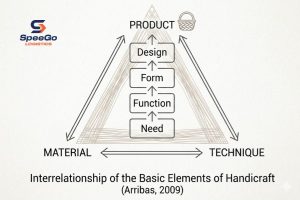
The three basic elements of handicrafts are material, design, and technique that do not function independently. In practice, they are closely interconnected, and any change in one element will directly affect the others. Understanding this relationship is essential for businesses that want to source handicraft products with consistent quality and scalable production.
3.1. Material and Design: A Two-Way Constraint
Material and design constantly influence each other. Flexible materials like rattan or seagrass allow curved and organic shapes but may lack structural strength, while rigid materials like wood or ceramics enable more defined forms but require different processing methods.
At the same time, design choices can increase material requirements or limit available options. Many sourcing issues arise when buyers prioritize visual design without confirming whether the selected material can support it in consistent production.
3.2. Technique as the Execution Layer
Technique is the element that turns material and design into a finished product. It defines how the material is processed and how the design is realized in practice. For example, weaving determines the structure of baskets, lacquer layering defines surface finish, and carving shapes the final details of wooden products.
3.3. Product – The Final Output of All Elements
The product is the final outcome of how material, design, and technique interact throughout the production process, and it reflects whether these elements have been properly aligned from the beginning. In handicraft sourcing, a product that looks appealing at the sample stage does not guarantee consistent results in bulk production.
What matters is whether it can be reproduced with stable quality, maintain its intended form and finish, and meet the expectations of the target market. Understanding how each basic element of handicraft interacts helps businesses reduce production risks and improve product consistency.
4. How Each Basic Element of Handicraft Affects Cost, Quality, and Scalability?
Three elements of handicraft directly influence cost structure, product quality, and the ability to scale production. For B2B buyers working with Vietnamese suppliers, ignoring these factors often leads to unexpected risks after the order is placed.
4.1. Cost Structure
Each element plays a role in shaping the final cost of a handicraft product. Material is usually the most visible factor, but it is not the only one. Natural materials such as rattan or wood may appear cost-effective at first, yet variations in quality or availability can increase waste and production time.
Design also affects cost, more complex designs require additional labor, longer production cycles, and higher rejection rates. Technique further influences pricing, as skilled manual processes demand higher labor input. In handicraft manufacturing, cost is often influenced not just by raw materials, but by how efficiently each stage of production is managed.
4.2. Product Quality and Consistency
Quality is not defined by a single sample but by the consistency of the entire production batch. Material inconsistency can lead to differences in color, texture, or durability. Design that does not match production capability often results in defects or deviations. Technique, especially in manual processes, introduces variation depending on the skill level of artisans.
This is why many quality issues only appear during bulk production rather than at the sampling stage. Buyers who evaluate products based only on appearance may overlook underlying risks related to how the product is made. Maintaining product consistency in mass production is particularly challenging in handicrafts, where manual processes introduce natural variation.
4.3. Scalability and Production Capacity
One of the biggest challenges in sourcing handmade products is scaling from small orders to large volumes. A product that works well in small batches may become difficult to reproduce consistently when production increases. This is particularly common when the design is complex or when the technique relies heavily on highly skilled labor.
4.4. Supplier Selection
Understanding these elements also helps buyers choose suppliers more effectively. Not all factories are suitable for every product type. Some specialize in certain materials, while others are stronger in specific techniques or product categories. A mismatch between product requirements and supplier capability often leads to delays, quality issues, or cost increases.
5. Conclusion
For businesses sourcing handicrafts from Vietnam, understanding the basic element of handicrafts is only the starting point. What matters in practice is how well these elements are controlled across real production.
Ensuring consistency in materials, design, and technique often requires more than remote communication. It involves supplier verification, sample validation, and ongoing production monitoring, especially when working with multiple craft villages or small-scale manufacturers.
At SpeeGo Logistics, we support businesses throughout this process, from supplier matching and factory checks to quality control and shipment coordination. This helps reduce production risks and ensures your products can be delivered consistently at scale.
Looking to source handicraft products from Vietnam with fewer risks?
Get in touch with our team to discuss your sourcing needs and explore suitable suppliers for your product line.