

Choosing between a Vietnam sourcing agent and a China sourcing agent is one of the most critical decisions for importers. The wrong choice can lead to delays, quality issues, or unexpected costs that directly impact your margins.
This guide breaks down the real differences between the two markets, helping you decide which sourcing strategy fits your product, budget, and growth stage.
1. Manufacturing Ecosystem
1.1. China sourcing agent.
China’s biggest advantage lies in how complete its manufacturing system is. In many regions, suppliers, component makers, and supporting services operate within the same industrial network. This allows sourcing agents to move quickly between factories, source additional parts when needed, and resolve production issues without disrupting the overall timeline. For products that involve multiple components or require coordination across different stages, this level of integration significantly reduces complexity.
Pros:
- Dense supplier network across almost all product categories
- Easier coordination for products with multiple components
- Faster adjustments when issues occur during production
- Access to specialized industrial clusters (e.g., electronics, textiles, consumer goods)
Cons:
- Increasing production costs, especially in major manufacturing hubs
- Less flexibility for small or experimental orders
- Higher risk exposure for proprietary designs if not managed carefully
In highly integrated environments like China, many product sourcing companies operate within established industrial clusters, allowing them to manage complex supply chains with minimal disruption.
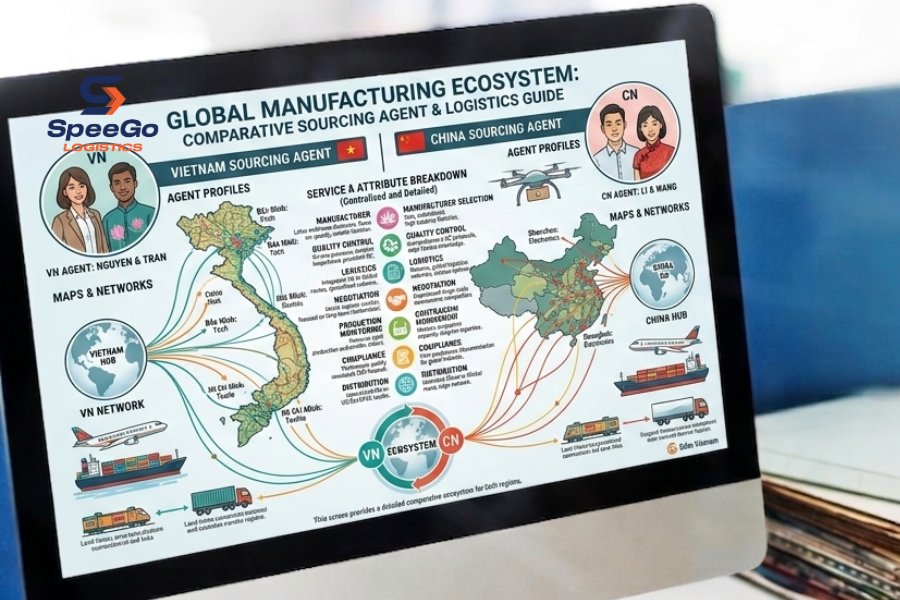
1.2. Vietnam sourcing agent.
Vietnam’s manufacturing ecosystem is still developing and is more focused on specific industries rather than full supply chain integration. Suppliers are often strong within their niche (such as furniture, textiles, or home decor), but may rely on external sources for materials or components. This means sourcing agents in Vietnam play a more active role in coordinating production and ensuring everything aligns across different vendors.
Pros:
- Strong specialization in key industries like furniture, textiles, and home goods
- Growing technical capability, especially in assembly and export manufacturing
- More flexibility when working with smaller suppliers or workshops
- Emerging industrial zones improving production capacity
Cons:
- Less diverse manufacturing base compared to China
- Limited capacity for highly complex or multi-component products
- Greater dependence on imported materials or components
- Requires more coordination from sourcing agents
In this context, a manufacturing sourcing agent plays a critical role in coordinating suppliers, managing production timelines, and ensuring consistency across different vendors in Vietnam.
2. Cost Structure
2.1. China sourcing agent
Working with a China sourcing agent usually means entering a system built around efficiency at scale. Chinese factories are structured to maximize output through automation, standardized processes, and years of production experience. This allows them to offset rising labor costs by producing faster and more consistently.
In practice, pricing in China is highly predictable. Suppliers often provide clear cost breakdowns, and once production is stabilized, repeat orders tend to maintain consistent pricing. This is particularly valuable for businesses that rely on long-term cost planning.
Pros:
- High production efficiency reduces unit cost at large volumes
- Stable and predictable pricing for repeat orders
- Ability to handle specialized products with existing infrastructure
- Strong cost control when scaling production
Cons:
- Higher labor and operational costs compared to Vietnam
- Tariff exposure in some export markets
- Less cost-effective for small or trial orders
- Additional costs may appear in tooling or setup for new designs
2.2. Vietnam sourcing agent
With a Vietnam sourcing agent, the cost structure is driven more by labor advantage and operational flexibility than by automation. Manufacturing wages in Vietnam are typically 30 – 50% lower than in China, depending on the industry and region. In addition, factory space, utilities, and general operating costs are also more affordable, which helps reduce overall production expenses.
This makes Vietnam particularly attractive for labor-intensive products and businesses that want to control upfront investment. Many suppliers are willing to work with smaller orders, allowing buyers to test products before scaling.
Vietnam also benefits from multiple trade agreements such as CPTPP and EVFTA, which can lead to more favorable tariff conditions in markets like Canada, Australia, and the EU. This advantage is often not visible in initial quotes but becomes clear when calculating total landed cost.
Pros:
- Lower labor and operating costs
- Competitive pricing for labor-intensive products
- More accessible entry point for small and medium orders
- Favorable tariff treatment in multiple export markets
Cons:
- Less predictable pricing structure compared to China
- Possible hidden costs during setup or sampling stages
- MOQs can vary depending on supplier capability
- Limited cost optimization for highly automated products
If you are planning to import from Vietnam, understanding supplier verification and logistics is equally important.
3. Quality Control
3.1. China sourcing agent
Quality control in China is built into the system rather than handled case by case. Most export-oriented factories already operate with structured workflows, documented checkpoints, and familiarity with international standards. China also has a strong network of third-party inspection firms. This allows buyers to verify quality without being physically present, which is especially useful for large or repeat orders.
That said, not all factories perform at the same level. The gap between top-tier and mid-tier suppliers can be significant. Without clear specifications, some manufacturers may adjust materials or processes to protect margins.
Pros:
- Structured and repeatable quality systems
- Strong experience with international standards
- Easy access to third-party inspection services
- Consistent output for large-volume production
Cons:
- Quality level depends heavily on supplier tier
- Risk of unnoticed material changes without strict control
- Errors can scale quickly in mass production
3.2. Vietnam sourcing agent
In Vietnam, quality control depends less on systems and more on how production is managed day to day. Many factories have improved significantly, especially those supplying international clients, but the level of standardization is still uneven.
Pros:
- Reliable quality in established export sectors
- Continuous improvement in factory standards
- Strong results for products involving manual work
Cons:
- Less consistency across different suppliers
- Limited support infrastructure for testing and inspection
- Requires more direct involvement during production
As a result, experienced sourcing companies in Vietnam often combine on-site inspections with supplier relationship management to maintain consistent quality.
4. Product Capability
4.1 China sourcing agent.
China has a clear advantage in complex and technical products. Industries such as electronics, machinery, and multi-component goods rely on its advanced manufacturing infrastructure. A sourcing agent in China can easily manage projects that require multiple specialized suppliers working together.
4.2. Vietnam sourcing agent.
Vietnam performs well in product categories that rely on craftsmanship or simpler production processes. This includes furniture, home décor, textiles, and certain consumer goods. Sourcing agents in Vietnam are often more effective when working with products that require design flexibility rather than technical complexity.
This is especially relevant for businesses sourcing items made in Vietnam that require craftsmanship and design flexibility.
5. Communication and Working Style
5.1. China sourcing agent.
China’s sourcing environment is highly process-driven. Communication is often fast and structured, especially with experienced export factories. However, flexibility in negotiation may be limited once production terms are fixed.
5.2. Vietnam sourcing agent.
Vietnamese suppliers tend to have a more relationship-based working style. Communication may be slightly slower, but there is often more room for discussion and adjustment. Vietnam sourcing agents usually act as a bridge to align expectations and avoid misunderstandings.
In many cases, an import export consultant is needed to bridge communication gaps and ensure that both technical requirements and compliance standards are clearly understood.
When Should You Choose a Vietnam Sourcing Agent Over China?
Instead of asking which country is “better,” experienced buyers look for fit between product, budget, and growth stage.
You are launching a new product and want to control risk
At the early stage, uncertainty is high. You are still testing demand, refining design, and validating your market. Committing to large MOQs too early can lock up cash and increase risk. Vietnam sourcing agents are often a better fit in this situation. Many suppliers are open to smaller production runs, especially in categories like home décor, furniture, and textile
Your product depends on design, materials, or craftsmanship
Some products are not purely industrial, they rely on how they look and feel. In these cases, small details such as finish, texture, or proportions directly affect how well the product sells. Vietnam performs particularly well in categories where manual work and design interpretation matter. A sourcing agent in Vietnam can help you work closely with suppliers.
You need flexibility in MOQ and customization
If your business relies on frequent product updates, such as launching new collections, testing seasonal designs, or developing private label variations, rigid production systems can quickly become a limitation
In this context, a Vietnam sourcing agent often provides a more practical advantage. Vietnamese suppliers are generally more open to adjusting specifications, working with smaller initial quantities, and refining products based on feedback during the sampling stage.
Looking for a reliable Vietnam sourcing agent?
Get in touch with SpeeGo Logistics to receive a curated supplier shortlist, sample support, and full sourcing assistance tailored to your product and market.
Or request a free consultation to compare Vietnam vs China sourcing for your specific product, we’ll help you choose the most cost-effective and scalable option.