


How to calculate chargeable weight is essential for businesses involved in international shipping, air freight, and eCommerce logistics. Since carriers often charge based on either actual weight or volumetric weight, inaccurate calculations can lead to unexpected freight costs.
1. What Is Chargeable Weight?
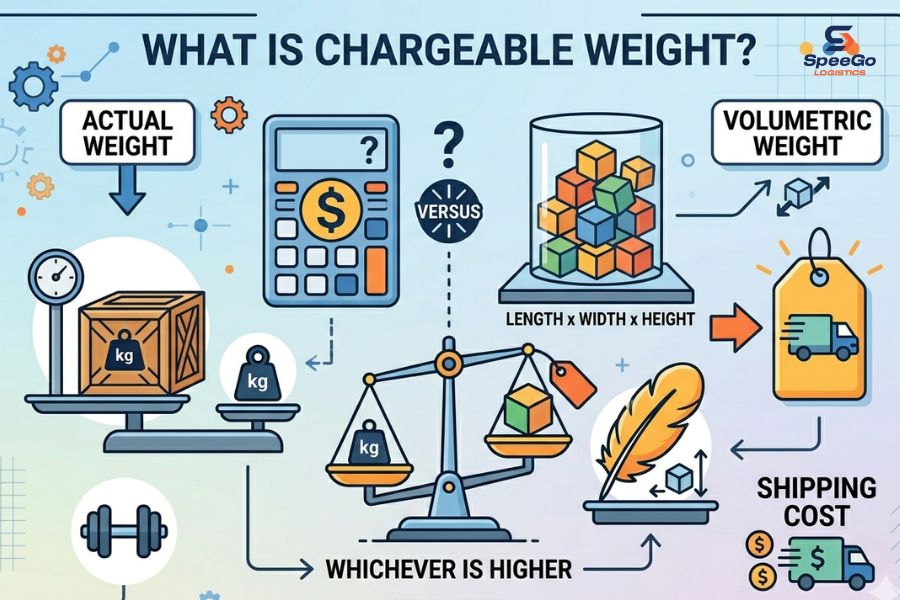
Chargeable weight is the weight carriers use to calculate shipping costs. It is not always the actual physical weight of the shipment. Instead, carriers compare the actual weight with the volumetric weight and charge based on whichever value is higher.
If a package is lightweight but occupies a large amount of cargo space, the volumetric weight may become higher than the actual weight. In that situation, the carrier charges based on volumetric weight instead of physical weight.
2. How to Calculate Chargeable Weight Step by Step?
How to calculate chargeable weight is essential for businesses involved in international shipping, air freight, and courier logistics. Carriers use chargeable weight to determine shipping costs based on either the shipment’s physical weight or the amount of cargo space it occupies.
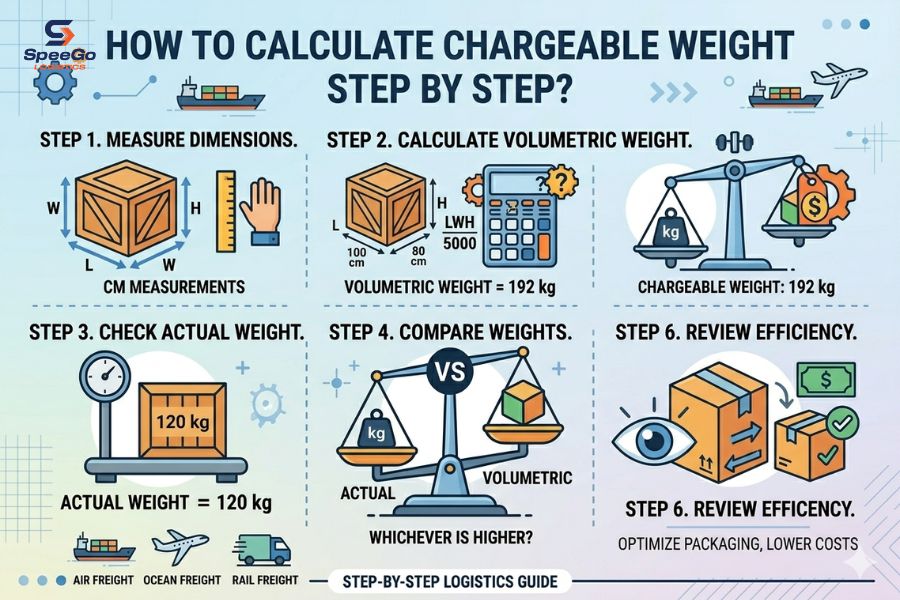
2.1. Step 1: Measure the Package Dimensions
The first step is measuring the shipment accurately. Businesses need to record including length, width and height. Measurements are usually taken in centimeters for international shipping calculations.
2.2. Step 2: Calculate the Volumetric Weight
After measuring the package, the next step is calculating volumetric weight using the standard volumetric weight formula.
Volumetric Weight (kg)= [Length (cm)×Width (cm)×Height (cm)]\5000
The divisor may vary depending on the carrier. Some logistics providers use 5000, while others may use 6000 for international air freight calculations.
Different transportation methods use different density ratios when calculating volumetric weight. These ratios help carriers estimate how much cargo space a shipment occupies compared to its physical weight.
- Air Freight (1:6 Density Ratio): Commonly uses a 1:6 density ratio because aircraft cargo space is limited and highly valuable. In many cases, airlines and courier companies divide the shipment volume by 6,000 to calculate volumetric weight.
- Ocean Freight (1:1 Density Ratio): Typically uses a 1:1 density ratio for less-than-container-load (LCL) shipments because container space is calculated differently from air cargo.
- Rail Freight (1:3 Density Ratio):Often applies a 1:3 density ratio because train cargo capacity balances both weight and available cargo space.
2.3. Step 3: Check the Actual Weight
After calculating volumetric weight, the shipment’s actual physical weight must be measured using a scale. This includes both the products and all packaging materials used for shipping.
2.4. Step 4: Compare both weight values
Carriers compare the actual weight and volumetric weight to identify which value is higher. The larger number represents the greater impact on transportation capacity and becomes the basis for freight pricing.
2.5. Step 5: Determine the chargeable weight
The final chargeable weight is the higher value between actual weight and volumetric weight. This number is used by logistics providers to calculate international shipping charges.
2.6. Step 6: Review shipping efficiency
Businesses should regularly review packaging size and freight calculations to reduce unnecessary cargo space and optimize shipping costs. Efficient packaging strategies can help lower chargeable weight and improve overall logistics performance.
Improving shipping efficiency starts with smarter logistics planning and optimized freight management. SpeeGo Logistics supports businesses with flexible international shipping solutions to help reduce chargeable weight.
3. Common Mistakes When Calculating Chargeable Weight
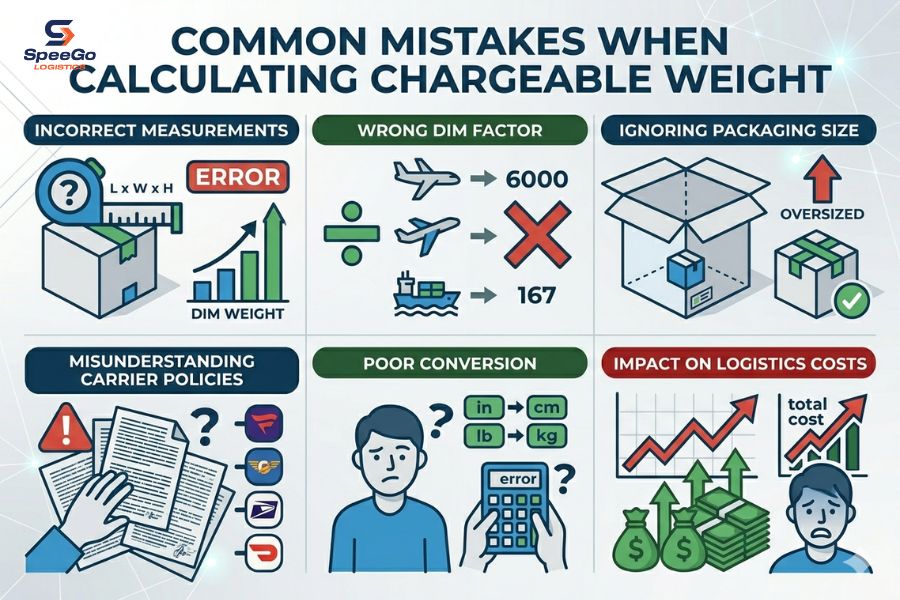
Calculating chargeable weight incorrectly can lead to higher shipping expenses, inaccurate freight quotes, and unexpected logistics costs. Many businesses underestimate how small measurement errors or incorrect shipping data can affect international freight pricing.
3.1. Incorrect package measurements
Incorrect package dimensions are one of the most common causes of shipping calculation errors. Even small measurement mistakes can increase volumetric weight and lead to higher freight charges, especially in air freight and express shipping services.
3.2. Using the wrong DIM factor
Different transportation methods and carriers use different dimensional weight conversion factors when calculating chargeable weight. Using the wrong DIM factor may result in inaccurate freight estimates and unexpected international shipping costs.
3.3. Ignoring packaging size
Oversized packaging and excessive empty space can significantly increase volumetric weight, even when the products themselves are lightweight. Optimizing packaging dimensions helps businesses reduce chargeable weight and improve shipping efficiency.
3.4. Misunderstanding carrier policies
Each logistics provider may apply different pricing rules, rounding methods, or oversized cargo policies. Businesses that fail to review carrier-specific shipping requirements may encounter additional freight charges or billing discrepancies.
3.5. Impact on logistics costs
Chargeable weight calculation mistakes can increase transportation expenses and reduce supply chain efficiency over time. Accurate freight calculations help businesses improve budgeting, optimize packaging strategies, and manage international shipping costs more effectively.
4. Tips to Reduce Chargeable Weight and Shipping Costs
Reducing chargeable weight is one of the most effective ways for businesses to control international shipping expenses. Optimizing packaging and cargo efficiency can significantly lower logistics costs over time.
4.1. Optimize packaging dimensions
Reducing oversized packaging helps businesses lower volumetric weight and improve cargo space efficiency. Using cartons that better match product dimensions can significantly reduce international shipping costs over time.
4.2. Reduce empty space inside packages
Excess empty space increases shipment dimensions unnecessarily and may raise chargeable weight. Businesses can improve packaging design and product arrangement to minimize unused cargo space and optimize freight efficiency.

4.3. Use lighter packaging materials
Lightweight packaging materials help reduce both actual weight and transportation costs while still protecting products during shipping. This is especially important for air freight and express courier services where weight directly affects freight pricing.
4.4. Work with experienced logistics partners
Experienced logistics providers can help businesses improve packaging strategies, optimize shipping routes, and reduce unnecessary freight expenses. Professional shipping support also helps companies manage carrier-specific dimensional weight policies more effectively.
Looking to reduce freight costs and improve international shipping efficiency? SpeeGo Logistics helps businesses optimize packaging, manage chargeable weight calculations, and streamline global transportation operation.
4.5. Use consolidated shipping strategies
Consolidated shipping combines multiple smaller shipments into larger freight loads to maximize transportation efficiency. This strategy can help businesses lower per-unit shipping costs and improve cargo utilization in international logistics operations.
4.6. Improve long-term logistics efficiency
Reducing chargeable weight is not only about lowering immediate freight costs. Efficient packaging and shipping strategies also support better supply chain performance, improved transportation planning, and more sustainable logistics operations.
5. Chargeable Weight FAQs
5.1. Is volumetric weight always higher?
No, volumetric weight is not always higher than actual weight. Heavy and compact shipments often have a greater physical weight than volumetric weight. However, lightweight packages with large dimensions usually generate higher volumetric weight and may result in increased shipping charges.
5.2. Does chargeable weight apply to all freight methods?
Yes, chargeable weight applies to several transportation methods, including air freight, rail freight, courier shipping, and less-than-container-load (LCL) ocean freight. However, each freight method may use different volumetric conversion ratios based on cargo capacity and transportation efficiency requirements.
5.3. Do different courier companies use different chargeable weight formulas?
Yes, different courier companies may use different dimensional weight formulas and conversion factors when calculating chargeable weight. Some express carriers use a divisor of 5000, while others apply 6000 depending on the shipping service, transportation mode, or destination country.
5.4. Does chargeable weight affect eCommerce businesses differently from traditional retailers?
Yes, chargeable weight often affects eCommerce businesses more significantly because online retailers usually ship smaller parcels with higher shipping frequency. Products sold through eCommerce platforms may also use protective packaging that increases volumetric weight. In contrast, traditional retailers often move bulk shipments through palletized freight or container shipping, which can reduce the impact of dimensional pricing
5.5. What types of products are most affected by volumetric weight pricing?
Large but lightweight products are typically the most affected by volumetric weight pricing because they occupy significant cargo space without adding much physical weight. Common examples include pillows, home décor items, plastic products, footwear, toys, sports equipment, and lightweight furniture.
How to calculate chargeable weight is essential for businesses looking to manage international shipping costs more effectively. Since freight charges are often based on both actual weight and volumetric weight, accurate calculations can help companies avoid unexpected expenses.