


If you are planning to import cosmetics to Canada, understanding the regulations, requirements, and process is essential to avoid delays and compliance risks. Canada has strict cosmetic import regulations enforced by Health Canada, covering product classification, labeling, ingredient safety, and notification procedures.
Importing cosmetics to Canada requires compliance with Health Canada regulations, including:
- Submitting a Cosmetic Notification Form (CNF)
- Ensuring bilingual labeling (English & French)
- Verifying ingredients against the Cosmetic Ingredient Hotlist
- Preparing customs documentation and HS codes
- Paying applicable taxes (GST, PST, or HST)
Following these steps helps businesses avoid delays and successfully enter the Canadian market.
1. Overview of Cosmetic Regulations in Canada
Before you import cosmetics to Canada, it is crucial to understand the regulatory requirements set by Health Canada. These regulations ensure that all cosmetic products are safe, properly labeled, and compliant with ingredient restrictions.
Canada has developed a well-structured regulatory environment for cosmetics, with a strong focus on consumer safety, clear labeling, and full transparency of ingredients. Multiple federal laws form the foundation of this framework, including the Food and Drugs Act, Cosmetic Regulations, Consumer Packaging and Labelling Act, and Hazardous Products Act. Together, these regulations ensure that cosmetic products are produced, packaged, and distributed in a way that minimizes potential risks to consumers.
| Regulation Aspect | Definition | Consequences of Non-Compliance |
| Regulatory Framework | Cosmetic products in Canada are regulated under several key laws, including the Food and Drugs Act, Cosmetic Regulations, Consumer Packaging and Labelling Act, and the Hazardous Products Act. These collectively set the legal foundation for product safety and compliance. | Non-compliant products may be denied entry, recalled from the market, or subject to legal penalties and fines. |
| Notification Requirement | Businesses must submit a Cosmetic Notification Form (CNF) to Health Canada within 10 days after the product is first sold or if any formulation changes occur. | Failure to submit CNF can lead to product removal from the market or regulatory enforcement actions. |
| Labelling Requirements | Labels must be presented in both English and French and include essential details such as product name, net quantity, ingredient list (INCI format), usage instructions, expiry date (if applicable), allergen information, and safety warnings. | Incorrect or missing labels can result in shipment delays, refusal at customs, or product destruction. |
| Responsible Person | There is currently no mandatory requirement to appoint a specific “responsible person” for cosmetic products in Canada. | Lack of clear accountability may complicate compliance management and increase regulatory risk if issues arise. |
| Ingredient Restrictions | Canada maintains a “Hotlist” that identifies substances which are either prohibited or allowed only under certain conditions in cosmetic formulations. | Use of prohibited substances can lead to immediate import bans, product recalls, and reputational damage. |
| Animal Testing | Animal testing for cosmetics has been banned since December 2023, although limited exceptions may apply where historical safety data is involved. | Non-compliance may result in product rejection and potential legal consequences. |
| Product Safety Testing | Pre-market approval is not required. However, companies are fully responsible for ensuring their products meet all applicable safety standards before entering the market. | Unsafe products may trigger recalls, consumer complaints, and liability claims. |
| Sustainability Requirements | While not as strict as in some regions like the EU, Canada is placing growing importance on sustainability, including environmentally responsible practices and transparency in product composition. | Failure to meet evolving expectations may reduce market competitiveness and affect brand perception. |
| Market Surveillance and Compliance | Health Canada actively oversees the market through inspections, post-market monitoring, and enforcement actions, with a focus on product safety and ingredient compliance. | Non-compliant products may be investigated, fined, or removed from the market after entry. |
2. Importing Cosmetics Process to Canada
Entering the Canadian beauty market can be highly rewarding, but only if the process is handled correctly from the beginning. Below is a practical, step-by-step guide to help your business import cosmetics to Canada efficiently while staying compliant with regulations.
2.1. Identify What is a “Cosmetic” in Canada?
Before starting the import process, it’s essential to understand how beauty and personal care products are classified in Canada. According to Health Canada, a “cosmetic” generally refers to products used for cleansing, improving, or altering appearance without affecting the body’s structure or functions.
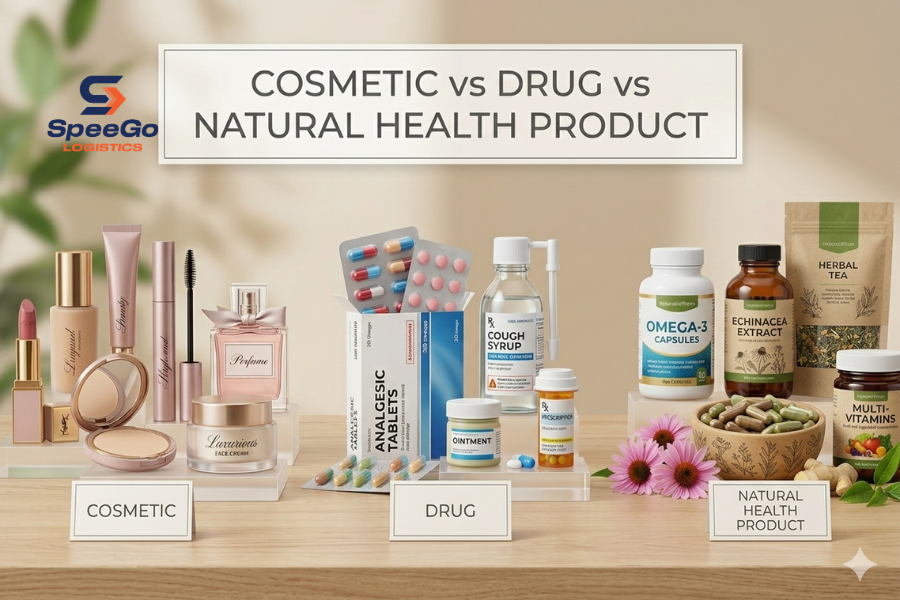
Typical cosmetic categories include:
- Makeup products (e.g., foundation, lipstick, mascara).
- Skincare items (such as moisturizers, cleansers, and face masks).
- Fragrances and perfumes.
- Hair care products (including shampoos, conditioners, and hair dyes).
- Deodorants and body sprays.
If a product is marketed with claims such as treating acne, preventing skin conditions, or delivering anti-aging effects at a therapeutic level, it may fall under a different category. These categories may be a natural health product or even a drug. It is subject to stricter regulatory requirements and approval processes.
Cosmetic vs Drug vs Natural Health Product in Canada
| Cosmetic | Drug | Natural Health Product | |
| Definition | Products used to cleanse, improve, or alter appearance without affecting body functions. | Products intended to diagnose, treat, prevent, or cure diseases. | Products derived from natural sources used to maintain or improve health. |
| Examples | Makeup, skincare, perfumes, shampoos, deodorants. | Acne treatments, medicated creams, anti-dandruff treatments with active ingredients. | Vitamins, herbal supplements, probiotics, traditional remedies. |
| Pre-market Approval | Not required. | Required (strict approval process). | Required (product license). |
| Notification Requirement | Cosmetic Notification Form (CNF) within 10 days after sale. | Not applicable (requires full approval before sale). | Must obtain Natural Product Number (NPN) before sale. |
| Product Claims | Limited to cosmetic benefits (e.g., “moisturizes”, “cleans”). | Can make therapeutic claims (e.g., “treats acne”). | Can make health claims supported by evidence (e.g., “supports immunity”). |
| Testing & Safety | No pre-approval, but safety must be ensured by company. | Extensive clinical and safety data required. | Evidence-based safety and efficacy required. |
2.2. Notify Health Canada Before Importing
One of the most important requirements when importing cosmetics to Canada is submitting the Cosmetic Notification Form (CNF). This is a mandatory step under Health Canada cosmetic rules and applies to all importers and manufacturers.
Although Canada does not require pre-market approval for cosmetics, submitting this form is a legal obligation and a key step in ensuring compliance.
To meet the requirements, importers should:
- Submit the CNF within 10 days after the product is first sold in Canada
- Provide a complete ingredient list using INCI (International Nomenclature of Cosmetic Ingredients) names
- Include detailed information about the manufacturer and distributor
It’s important to note that while product testing or pre-approval is not required, failure to file the CNF can lead to regulatory issues or delays in market access.
If you’re new to the process, following a structured approach to documentation and customs procedures can make a significant difference. Working with experienced logistics or compliance partners like SpeeGo Logistics can help ensure that all forms are submitted correctly and on time, reducing the risk of disruptions during import.
2.3. Ensure Proper Labeling and Packaging
In Canada, cosmetic labels must meet strict standards set by Health Canada to ensure transparency and consumer safety. Labeling issues are the primary reason shipments are flagged or delayed at the border. To avoid these risks, businesses must ensure full compliance with regulations set by the Food and Drugs Act and its accompanying Cosmetic Regulations.
To meet these standards, cosmetic labels must include:
- A complete ingredient list using INCI (International Nomenclature of Cosmetic Ingredients) names.
- The product identity (name or function) in both English and French
- Manufacturer or distributor contact information (e.g., phone number, email, or website).
- Clear warnings or cautions, where applicable, in both languages.
- Directions for safe use, if required, also in English and French.
- Net quantity displayed in metric units (such as mL or g).
All information must be easy to read, permanently affixed, and free from misleading claims. Statements like “100% chemical-free” can raise red flags unless they are backed by scientific evidence. Labeling must also comply with other applicable legislation, including the Consumer Packaging and Labelling Act and the Canadian Environmental Protection Act, 1999 (CEPA). These laws further regulate how products are presented, packaged, and described in the Canadian market.
2.4. Handle Customs Clearance in Canada
Under the Canadian Customs Tariff system, most cosmetics are categorized within Chapter 33, which covers a wide range of products such as perfumes, skincare formulations, haircare items (including dyes), and makeup products. Each product type is assigned a specific classification code, and this determines not only how it is declared at customs but also how duties and taxes are applied.
Imported cosmetics from China or Vietnam that have trade agreements with Canada, may qualify for preferential or zero-duty treatment, this does not mean they are exempt from all import charges.
- 5% Goods and Services Tax (GST): Applied at the federal level.
- Provincial Sales Tax (PST) or Harmonized Sales Tax (HST): Depends on the final destination within Canada.
These costs can vary significantly between provinces and should be factored into your total landed cost from the beginning.
2.5. Arrange Shipping and Logistics
Shipping is a critical stage when you import cosmetics to Canada, as it directly affects cost, delivery time, and product integrity. Choosing the right transport method and the right logistics service, can significantly reduce risks and improve your overall supply chain performance.
The Right Shipping Method
- Air freight: Suitable for sample products or small cosmetics, high-value, or time-sensitive cosmetic products. While faster, it comes with higher costs, which may reduce your profit margin if not planned carefully.
- Sea freight: A more economical option for bulk shipments, especially when shipping from Vietnam to Canada. This method is widely used by importers looking to scale their business efficiently.
When shipping cosmetics from Vietnam to Canada, businesses must choose between air freight and sea freight depending on cost, volume, and delivery time. This step plays a critical role in maintaining product quality and controlling logistics expenses.
3. Documents Required to Import Cosmetics to Canada
To import cosmetics to Canada smoothly, businesses must prepare the following documents:
- Commercial invoice.
- Packing list.
- Bill of lading or airway bill.
- Cosmetic Notification Form (CNF).
- Product ingredient list (INCI format).
- Labeling compliance documents.
- HS code classification.
Incomplete or incorrect documentation is one of the main causes of customs delays.
4. Cost to Import Cosmetics to Canada: Duties, Taxes & Hidden Fees
Understanding the cost to import cosmetics to Canada is essential for pricing and profitability. Importers must consider not only product cost and shipping fees but also taxes, duties, and hidden charges during customs clearance.
4.1. Product Cost (EXW or FOB Pricing)
The first and most visible expense is the product cost quoted by your supplier. This is usually based on:
- EXW (Ex Works): You handle all logistics from the supplier’s factory
- FOB (Free on Board): The supplier delivers goods to the port of origin
For beginners, FOB pricing is often safer, as it simplifies coordination. However, experienced importers may prefer EXW for better control over shipping cost cosmetics.
4.2. Shipping Costs (Air vs. Sea Freight)
If you are planning to import from China or Vietnam, sea freight is typically more economical for bulk orders. Within sea freight, your cost depends on:
- FCL (Full Container Load): Lower cost per unit for large shipments
- LCL (Less than Container Load): Flexible for small volumes but higher cost per cubic.
4.3. Import Duties and Taxes in Canada
When goods arrive in Canada, you must pay applicable duties and taxes. These include:
- Provincial Sales Tax (PST): A separate tax imposed by certain provinces, such as British Columbia and Saskatchewan. The rate varies depending on the province and is applied in addition to GST, rather than being combined with it.
- Quebec Sales Tax (QST): A province-specific tax applied in Quebec, administered independently from GST. Businesses importing into Quebec must account for both GST and QST, each calculated under its own system.
- Goods and Services Tax (GST): A federal tax set at 5%, applied to most goods and services across Canada. It is collected by the federal government and typically applies to all imported products at the point of entry.
- Harmonized Sales Tax (HST): A blended tax that combines GST and PST into a single rate. It is used in provinces like Ontario and Nova Scotia, simplifying tax collection by applying one unified percentage instead of two separate taxes.
5. Common Mistakes to Avoid When Importing Cosmetics
Many businesses fail to import cosmetics to Canada successfully due to avoidable mistakes related to regulations, labeling, and documentation. Understanding these risks can help you stay compliant and reduce unnecessary costs, especially for newbies.
- Incorrect or non-compliant labeling: One of the most frequent compliance issues in Canada involves labeling errors. Cosmetics sold in Canada must follow strict requirements in Industry Guide for the labelling of cosmetics.
- Ignoring restricted or prohibited ingredients: Some importers rely entirely on suppliers without verifying ingredient safety. This creates serious cosmetic import risks, especially if products contain substances listed in the Cosmetic Ingredient Hotlist.
- Incomplete or incorrect documentation: Missing paperwork is a major cause of delays at customs. Common issues include incorrect invoices or HS codes, missing Cosmetic Notification Form (CNF) and inconsistent product descriptions.
- Skipping product testing and market validation: Importing large quantities without testing the market is a risky move. Consumer preferences in Canada may differ from those in your supplier’s country.
By focusing on proper labeling, verified ingredients, accurate documentation, and the right logistics service, you can reduce risks and operate with confidence.
6. Choosing the Right Logistics Partner for Cosmetic Imports
SpeeGo Logistics offers a specialized logistics service designed for businesses importing cosmetics into Canada. With hands-on experience in shipping from Vietnam to Canada, SpeeGo supports clients at every stage from supplier coordination to final delivery.
Why choose SpeeGo Logistics for importing cosmetics to Canada?
- Expertise in Health Canada compliance and CNF submission.
- Experience in shipping cosmetics from Vietnam to Canada.
- End-to-end support: documentation, customs clearance, and delivery.
- Cost optimization for both air and sea freight.
With SpeeGo, you can reduce delays, avoid compliance risks, and scale your cosmetics business faster.
Ready to import cosmetics to Canada without hassle?
Partner with an experienced logistics team to simplify compliance, reduce costs, and speed up your supply chain.
Contact SpeeGo Logistics today for a tailored import solution and start growing your cosmetics business with confidence.
Frequently Asked Questions (FAQ)
- Can I import private label cosmetics into Canada?
Yes. Many businesses import private label cosmetics. You are responsible for ensuring the product complies with Canadian regulations, even if it is manufactured overseas.
- Should I work with a logistics service provider?
Yes. A professional logistics service provider helps manage documentation, shipping, and customs clearance. This reduces delays and ensures compliance.
- Do I need a license to import cosmetics into Canada?
In most cases, you do not need a specific import license for cosmetics. However, you must comply with all regulations, including proper labeling and ingredient safety requirements.