

Many international businesses that previously relied heavily on China are now adopting a “China Plus One” strategy, which involves maintaining operations in China while expanding manufacturing or sourcing to additional countries. This approach allows companies to diversify their supply chains and reduce exposure to potential disruptions such as trade tensions, tariffs, or geopolitical uncertainty.
In the process of searching for suitable manufacturing markets to replace China, Vietnam has emerged as one of the most prominent alternatives in Asia. The country has attracted substantial foreign direct investment (FDI) from multinational corporations seeking cost-competitive production locations and stable export environments.
1. Vietnam vs China: Key Comparison Factors for Global Buyers
1.1. Lower Manufacturing Costs in Vietnam
One of the main reasons many international companies consider Vietnam as an alternative manufacturing base is its cost competitiveness, particularly in labor-intensive industries. Compared with more mature manufacturing economies, Vietnam generally offers lower labor costs and relatively affordable industrial operating expenses. These factors make the country attractive for businesses seeking to maintain competitive pricing while diversifying their supply chains.
Labor Cost Comparison
Labor cost differences are often a decisive factor in global manufacturing decisions. Over the past decade, wages in China have increased steadily as the country’s economy has developed and living standards have improved. Boston Consulting Group report shows that the average cost of labor in China was $6.5 per hour, whereas in Vietnam it was $3. Lower wage levels allow manufacturers in Vietnam to remain competitive in sectors where labor represents a significant portion of total production costs.
These lower wage levels help manufacturers remain competitive in sectors where labor represents a large portion of production costs. As a result, many global retailers that previously imported furniture from China or imported handicrafts from Vietnam are gradually shifting part of their sourcing to Vietnam to reduce overall production costs.
Factory Operating Costs
Beyond wages, overall factory operating expenses also influence manufacturing decisions. Operating costs include utilities, logistics services, regulatory compliance, and facility management. Vietnam has actively invested in industrial development zones and export processing zones to attract foreign manufacturers. The country’s industrial parks typically provide ready-built factory spaces, utilities infrastructure, and logistics connectivity that simplify the setup process for foreign companies (World Bank, Vietnam Overview, 2023).
1.2. Manufacturing capabilities
Even though China is still the biggest manufacturing hub in the world, known for its vast experience and huge production capabilities for all sorts of items, Vietnam is quickly closing the gap. China’s knack for making just about anything puts it in a commanding spot worldwide. In fact, a World Bank report from 2023 showed that China was responsible for over a quarter of all global high-tech exports, cementing its place as the top maker of advanced tech goods. Vietnam, while not as broad in its offerings, can still churn out most everyday products and is becoming a really important player in high-tech manufacturing. This growth is being fueled by major investments from big international companies like Samsung, LG Electronics, Nokia, and Intel, all pouring billions into their operations there.
1.3. Product quality
When it comes to products, quality really matters to both companies and the people buying them. Both Vietnam and China have gotten a lot better at making things and checking that they’re good quality.
The World Trade Organization’s 2020 report on Vietnam’s trade policies mentioned that Vietnam has 12,888 national standards, with 60% of them matching international or foreign ones. This is up from 40% back in 2013, and these standards cover pretty much everything. On top of that, Vietnam’s Ministry of Industry and Trade is pushing for even tougher rules for products coming out of the country.
China has also seen some serious improvements in product quality over time. Chinese manufacturers have been putting more effort into research, getting their quality control systems dialed in, and getting certified to meet worldwide standards. In China, companies that check quality have to follow the ISO17025 system, which is approved by the China National Accreditation Service for Conformity Assessment and is part of the International Laboratory Accreditation Cooperation.
1.4. Shipping logistics
China has developed one of the world’s most extensive international shipping networks, supported by a large number of freight forwarders, logistics providers, and global shipping lines. According to the United Nations Conference on Trade and Development (UNCTAD), Port of Shanghai handles more than 49 million TEUs of container throughput annually, making it the busiest container port in the world.
At the same time, Vietnam’s logistics sector has been developing rapidly, allowing local freight forwarders and shipping providers to compete more directly in global trade routes. The World Bank Logistics Performance Index shows that Vietnam has steadily improved its logistics capabilities over the past decade as export volumes continue to grow. Many Vietnamese logistics companies now provide end-to-end services, managing the process from factory pickup and export documentation to international freight and final delivery to warehouses in overseas markets.
1.5. Trade Agreements
Another important factor that makes Vietnam increasingly attractive to international businesses is its extensive network of free trade agreements (FTAs). These agreements reduce tariffs, simplify market access, and improve export competitiveness for goods manufactured in Vietnam. Vietnam is among the most trade-integrated economies in Asia due to its participation in numerous regional and global trade frameworks.
Several major agreements provide significant advantages for exporters manufacturing in Vietnam:
- Comprehensive and Progressive Agreement for Trans-Pacific Partnership (CPTPP): This agreement includes 11 member economies such as Canada, Japan, Australia, and Mexico. The CPTPP eliminates or significantly reduces tariffs on many goods traded between member countries.
- EU – Vietnam Free Trade Agreement (EVFTA): The European Commission reports that the agreement will eventually eliminate around 99% of tariffs on goods traded between the EU and Vietnam, making Vietnamese exports significantly more competitive in European markets.
- Regional Comprehensive Economic Partnership (RCEP): It’s currently the world’s largest trade agreement, covering major Asia-Pacific economies including China, Japan, South Korea, Australia, and ASEAN countries.
Comparison With China’s Trade Access
China also participates in several regional trade agreements, including RCEP and agreements with ASEAN countries. However, when it comes to preferential tariff access to Western markets, Vietnam can sometimes offer additional advantages. In contrast, Chinese exports to some Western markets may face standard import tariffs or additional trade restrictions depending on the product category and current trade policies. Preferential trade agreements can play a major role in shaping sourcing decisions because they affect both tariff levels and long-term market access.
2. Key Product Categories where Vietnam Excels
While China remains the world’s largest manufacturing economy, Vietnam has developed strong competitive advantages in several export-oriented industries.
2.1. Furniture and Wooden Products
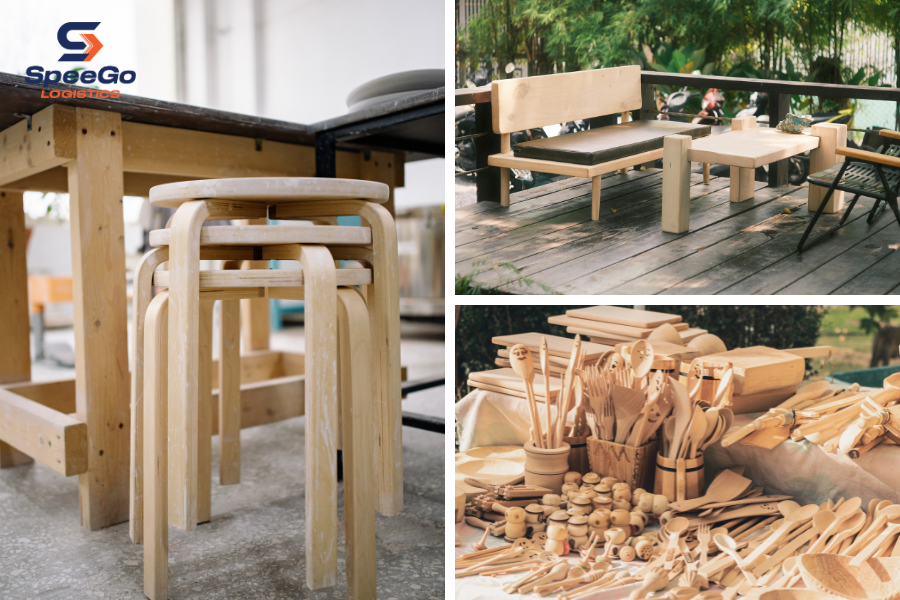
Vietnam has become one of the world’s leading exporters of wooden furniture and interior products when it reaches over USD 9.76 billion in 2025 (Mordor Intelligence, 2025). The country’s furniture industry benefits from a large network of manufacturers producing a wide range of products, including indoor wooden furniture, outdoor furniture, and handcrafted wood products. Vietnam’s woodworking sector has expanded significantly due to the availability of skilled labor and the development of specialized production clusters in provinces such as Binh Duong, Dong Nai, and Ho Chi Minh City.
In conclusion, Vietnam has become an increasingly attractive sourcing destination for companies that traditionally import furniture from China but are now expanding their supplier networks from Vietnam.
2.2. Textiles and Garments
Vietnam has been one of the top garment exporting countries globally, supplying major markets such as the United States, the European Union, and Japan. Vietnam Textile and Apparel Association (VITAS) shows that Vietnam’s textile and garment exports reached approximately USD $46 billion in 2025 (Hanh, 2026). Vietnam’s textile sector produces a wide range of products, including apparel, sportswear, and footwear, and supports millions of jobs across the country. The industry benefits from an extensive network of manufacturers, subcontractors, and export-oriented factories that specialize in large-scale production.
2.3. Agricultural and Food Products
Vietnam is also a major global exporter of several agricultural commodities. The country’s favorable climate and extensive farming areas allow it to produce a wide variety of crops that are widely traded in international markets. These agricultural products are widely imported by international food distributors and processing companies, making Vietnam an important supplier in global agricultural trade.
2.4. Handicrafts and Home Decor
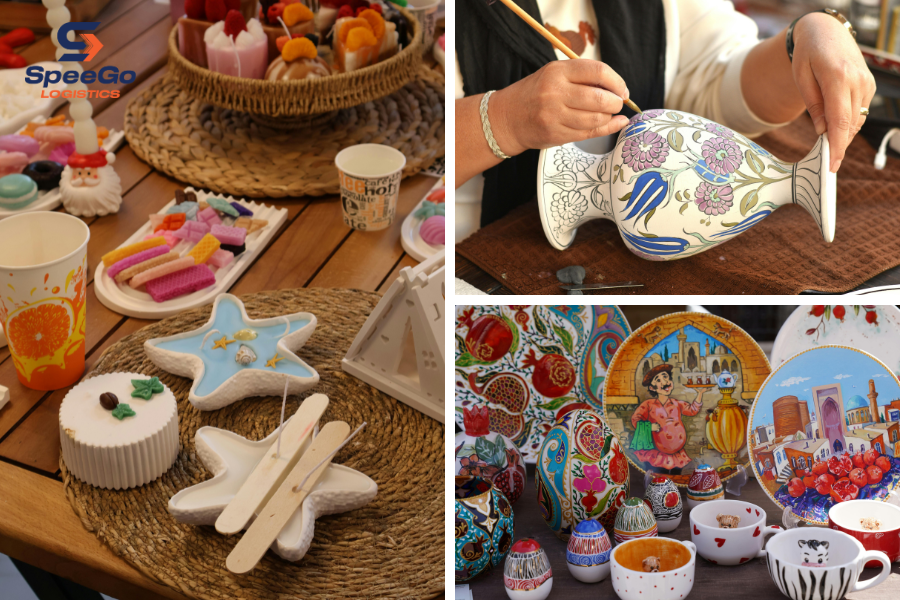
Vietnam has a long tradition of producing handcrafted decorative products and home decor items. The country’s handicraft industry combines traditional craftsmanship with export-oriented production, allowing manufacturers to supply both mass-market retailers and specialty home decor brands. Many of these products are produced in traditional craft villages that have specialized in handicrafts for generations. According to Vietnam’s Ministry of Industry and Trade, handicraft exports contribute significantly to rural employment and are widely exported to markets in North America, Europe, and Japan. If businesses need to import handicrafts, Vietnam is definitely a perfect place to source them.
3. Key considerations when choosing between Vietnam and China
When deciding whether to source from Vietnam or China, businesses should carefully review several practical factors before making a final choice.
- Product Type and Manufacturing Complexity: Vietnam is often a strong option for products that rely heavily on manual labor, such as garments, furniture, and handicrafts. However, items that involve advanced components, complex electronics, or highly specialized manufacturing processes may still benefit from China’s well-developed industrial ecosystem and mature supplier networks.
- Production Volume: China generally offers greater capacity for very large-scale manufacturing thanks to its extensive factory infrastructure and supply chains. While Vietnam’s manufacturing sector has expanded rapidly in recent years, production capacity in some industries may still be smaller compared with China.
- Cost Structure and Total Landed Cost: If cost efficiency is a key priority, businesses should conduct a full landed cost analysis rather than focusing solely on factory prices. This evaluation should include labor costs, raw materials, tariffs, logistics expenses, and potential compliance costs in the destination market.
- Lead Time and Delivery Schedule: Delivery timelines can vary depending on production complexity and shipping routes. Importers should consider both manufacturing lead time and international transit time when comparing suppliers in the two countries, especially if product availability is time-sensitive.
- Intellectual Property Protection: Companies sourcing from either country should take appropriate precautions to protect designs, branding, and proprietary technology. This typically involves clear contracts, non-disclosure agreements, and working with partners who follow established legal and compliance procedures.
- Long-Term Business Strategy: Beyond short-term cost comparisons, businesses should evaluate how each sourcing location aligns with their long-term goals. Factors such as supply chain diversification, production scalability, and market expansion can influence whether Vietnam, China, or a combination of both best supports future growth.
4. How to Choose Between Vietnam and China for Sourcing?
To answer the question “is made in Vietnam better than China?” when both countries had unique advantages. China continues to dominate global manufacturing thanks to its highly developed industrial ecosystem, advanced technology capabilities, and massive production capacity. However, Vietnam has emerged as a strong alternative for many international buyers, particularly in labor-intensive industries such as furniture, handicrafts, textiles, and home decor.
SpeeGo Logistics helps global importers manage the entire shipping process, from supplier pickup and export documentation to international freight and final delivery in overseas markets. With experience in handling shipments for furniture, handicrafts, and home décor products, SpeeGo provides tailored logistics solutions that help businesses reduce shipping risks and optimize transportation costs.
Frequently Asked Questions (FAQs)
- Is Vietnam cheaper than China for manufacturing?
Yes, Vietnam is generally cheaper than China, particularly in terms of labor costs and factory operating expenses. However, China may still be more cost-efficient for high-volume manufacturing due to its mature supply chain and large production scale.
- Is Vietnam a reliable alternative to China for sourcing?
Yes, Vietnam is widely considered a reliable alternative sourcing destination, particularly for companies adopting a “China Plus One” strategy.
- What industries are growing fastest in Vietnam?
Some of the fastest-growing industries in Vietnam include electronics manufacturing, furniture production, textiles and garments, and agricultural exports. Major global technology companies such as Samsung and Intel have invested heavily in electronics manufacturing in Vietnam, while traditional industries like furniture and handicrafts continue to expand in global markets.